FAA Part 107 Remote Pilot (UAG) Knowledge Test, Practice Exams
Revision Mode
Revise with instant feedback: the moment you pick an answer you see whether it was right, with the handbook-cited explanation. Untimed — ideal before you sit a mock test. Questions you miss keep coming back until you know them.
Exam Mode
Test-day conditions: no feedback until you submit, each knowledge area scored separately, with a full question-by-question review at the end.
The real test requires 70% to pass. Each knowledge area is scored separately here so you know exactly where you stand.
Knowledge areas & your progress
Unlock the full question bank
The free sample gives you about two exams' worth of questions per knowledge area. The full bank covers every knowledge area in depth, with source-cited explanations. $49, one time, lifetime access on up to 3 devices — all five tests (Mechanic General, Airframe, Powerplant, Part 107 Remote Pilot, and Inspection Authorization) included.
✓ One purchase, every written test · up to 3 devices · no subscription · no account needed
Score history
Reviews
Review
Frequently asked questions
How is the FAA Part 107 Remote Pilot (UAG) Knowledge Test structured?
The real Unmanned Aircraft General - Small written test has 60 multiple-choice questions (3 options each), a 2-hour time limit, and requires 70% to pass. Questions are drawn across 19 knowledge areas. These follow the FAA-S-ACS-10 blueprint, and this bank mirrors those areas and their weights.
What score do I need to pass?
70 percent. Revise each knowledge area to that level in Revision Mode, then run the full exam simulation in Exam Mode before your test date.
Are these real FAA exam questions?
The live test bank is not published. Our questions include the FAA's own published sample questions plus original questions written to the FAA-S-ACS-10 blueprint and grounded in 14 CFR parts 89 and 107, AC 107-2A, the Remote Pilot Study Guide, the Pilot's Handbook of Aeronautical Knowledge and the AIM, with the source cited in each explanation.
How many practice questions are included?
The full Unmanned Aircraft General - Small bank contains 592 questions with explanations. The free sample gives you roughly two exams' worth per knowledge area.
What else does the Part 107 certificate need?
The UAG knowledge test is the only exam. Pass it, then apply through IACRA for the Remote Pilot Certificate; there is no oral or practical. A certificate holder must also complete free recurrent training every 24 calendar months.
What does access cost?
$49, one time, for lifetime access to every test on the site and everything we add later. No subscription.
Can I use it on more than one device?
Yes. One purchase works on up to 3 of your devices. Your progress is saved on each device.
Do I need to create an account?
No. The practice tests run in your browser with no signup. Your score history is saved on your own device.
What topics does the FAA Part 107 Remote Pilot (UAG) Knowledge Test question bank cover?
It is organised into 19 modules that follow the exam's own content areas: Regulations: operating rules and limitations, Operations over human beings, Remote identification, Regulations: applicability, definitions and reporting, Regulations: certification, recency and waivers, Regulations: alcohol and drugs, Airspace classification, Potential flight hazards, Airspace operating requirements, Lighting and ground hazards, Effects of weather on performance, Weather sources and reports, Loading, balance and performance, Airport operations, Emergency procedures, Physiology and fitness for flight, Radio communication procedures, Aeronautical decision-making and Maintenance and preflight inspection. Each module is drilled and scored separately, so you can see exactly which areas are exam-ready and which still need work.
When was this question bank last updated?
Last updated 15 September 2026. The bank is revised whenever the source material it cites changes, and every question carries the source its explanation is drawn from.
Sample FAA Part 107 Remote Pilot (UAG) Knowledge Test practice questions
A selection of free questions with answers and explanations. Use the interactive modules above for timed, scored drills.
What happens once a laser event has been reported to an air traffic facility?
- A ground search is initiated by the facility in order to locate and then disable the laser source
- A general caution is broadcast every five minutes for 20 minutes and on the ATIS for one hour ✓
- A temporary flight restriction is issued by NOTAM covering the area for 24 hours
Why: When a laser event is reported to an air traffic facility, a general caution warning is broadcast on all appropriate frequencies every five minutes for 20 minutes, and broadcast on the ATIS for one hour following the report. AIM 7-6-13.
Does the exposed rotating parts requirement apply to Category 3 as well as Category 2?
- Yes, the same laceration requirement appears in the Category 3 eligibility provisions ✓
- No, Category 3 substitutes a lower impact energy limit for the laceration requirement
- No, Category 3 relies on the operating limitations instead of any aircraft requirement
Why: Both Category 2 and Category 3 eligibility require that the small unmanned aircraft not contain any exposed rotating parts that would lacerate human skin upon impact with a human being, and not contain any safety defects. 14 CFR 107.120 and 107.130.
Which of these is given as an example of an incapacitation that would prevent a crew member taking part?
- A migraine headache, or moderate to severe body aches or pains that prevent operational duties ✓
- A mild seasonal allergy that has been controlled with a non-drowsy medication for some years
- A minor injury to the non-dominant hand that does not affect the ability to hold the control station
Why: Examples of incapacitations include loss of the dexterity needed to operate the control station, inability to maintain see-and-avoid vigilance due to blurred vision, inability to maintain situational awareness due to illness or medication, and a debilitating condition such as a migraine.
Show more sample questions with answers & explanations
A bright strobe close to the remote pilot is making it hard to judge the aircraft's attitude and height. What may the remote pilot do?
- Reduce the intensity of the anti-collision lighting, if the pilot determines that is in the interest of safety ✓
- Switch the anti-collision lighting off entirely, provided a second visual observer is also watching the aircraft
- Continue the flight unchanged, because the intensity of the lighting may not be altered once airborne
Why: The remote PIC may reduce the intensity of the anti-collision light if the pilot determines it is in the interest of safety, for example where a bright strobe close by would prevent accurate observation of the aircraft's location, speed, attitude or altitude.
Can an aircraft be stalled at any airspeed?
- No, a stall can occur only at or below the published unaccelerated stalling speed
- No, a stall occurs once engine power has been reduced to idle while in level flight
- Yes, within the limits of its structure, whenever a sufficiently high angle of attack is imposed ✓
Why: Any aircraft, within the limits of its structure, may be stalled at any airspeed. When a sufficiently high angle of attack is imposed the smooth flow of air over an airfoil breaks up and separates, producing an abrupt change of flight characteristics and a sudden loss of lift.
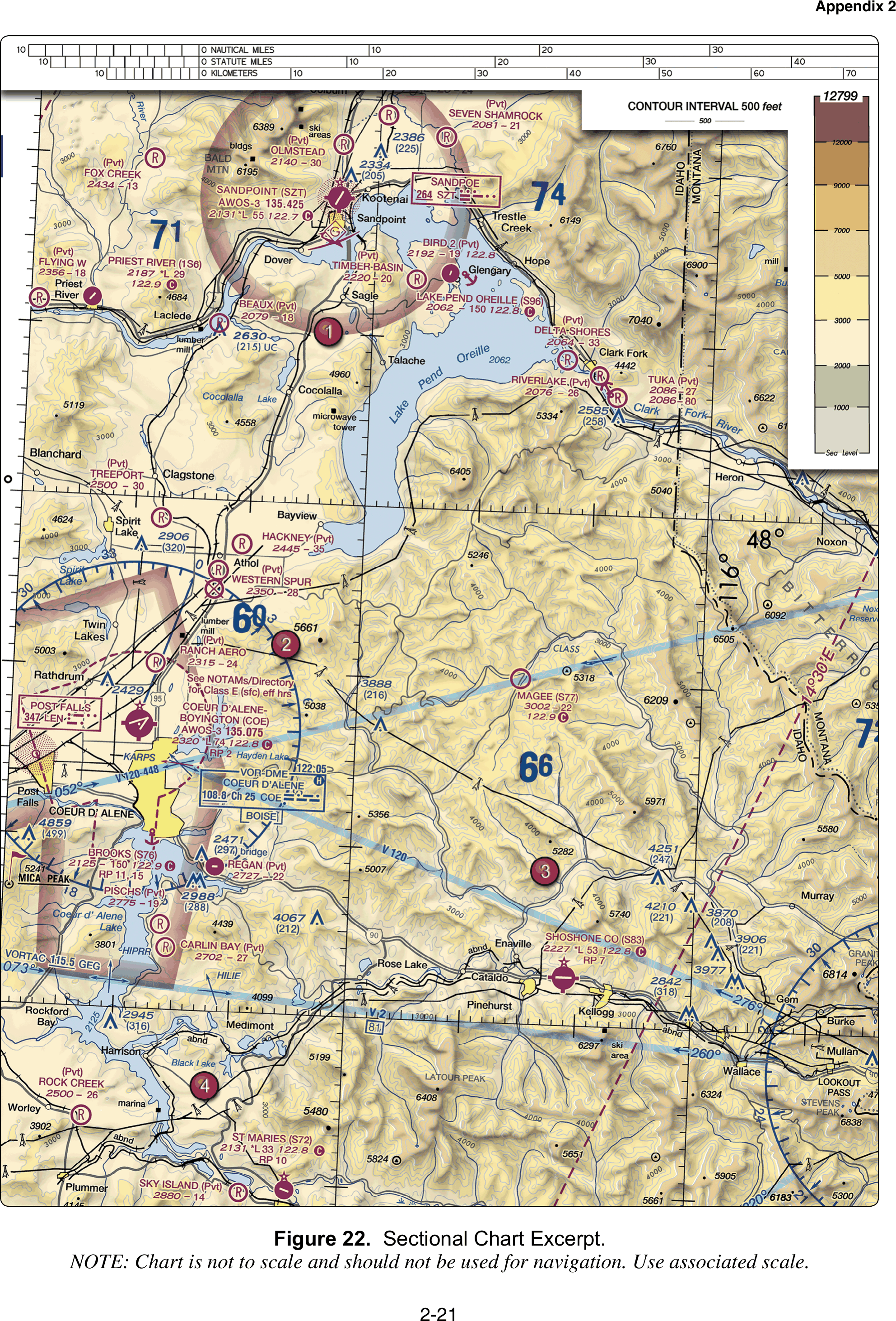
(Refer to FAA-CT-8080-2H, Appendix 2, Figure 22.) A remote pilot planning an operation near Coeur D'Alene-Boyington (COE) wants the current surface conditions there. Which frequency in the data block gives them?
- 122.05, which appears in the separate box below the airport
- 122.8, which appears at the end of the data block
- 135.075, which follows the letters AWOS-3 in the data block ✓
Why: The data block reads AWOS-3 135.075, naming the automated weather source and the frequency it broadcasts on. The 122.05 belongs to the separate Coeur D'Alene VOR-DME box, and 122.8 is the airport's common traffic advisory frequency.
What is dual obstruction lighting?
- Flashing red beacons with steady red lights at night, and high intensity white lights by day ✓
- Flashing white beacons with steady white lights at night, and red lights by day
- Flashing red beacons by day, with the obstruction lighting extinguished entirely during the night
Why: Dual lighting is a combination of flashing red beacons and steady red lights for nighttime operation and high intensity white lights for daytime operations. It is one of the three listed obstruction lighting conditions. PHAK ch.14.
What lighting must a small unmanned aircraft display to operate at night?
- Anti-collision lighting visible for at least 3 statute miles ✓
- A steady white light visible for at least 3 statute miles
- Position lights visible for at least 2 statute miles
Why: Night operation requires lighted anti-collision lighting visible for at least 3 statute miles with a flash rate sufficient to avoid a collision. The remote PIC may reduce its intensity if safety requires, but may not extinguish it. 14 CFR 107.29(a)(2).
What are the principal obstacles to maintaining situational awareness?
- Fatigue, stress and work overload, which can make a pilot fixate on one perceived important item ✓
- Bright sunlight, high humidity and strong crosswinds, which obscure the aircraft from view
- Unfamiliar airspace, new equipment and long flights, which are outside the pilot's experience
Why: Fatigue, stress and work overload can cause a pilot to fixate on a single perceived important item and reduce overall situational awareness of the flight. A distraction that diverts the pilot's attention from monitoring the aircraft is a contributing factor in many accidents.
Which preflight item concerns the number of GPS satellites the aircraft has acquired?
- Verifying the aircraft has acquired GPS location from the minimum number of satellites the manufacturer specifies ✓
- Verifying the aircraft has acquired a GPS location fix from at least four separate satellites, as part 107 requires
- Verifying the aircraft has acquired GPS location from the satellites listed in the current NOTAMs
Why: The recommended preflight inspection includes verifying communication with the small unmanned aircraft and that it has acquired GPS location from the minimum number of satellites specified by the manufacturer. Part 107 sets no satellite count of its own.
Who becomes an applicant when a small unmanned aircraft already listed on a declaration of compliance is modified?
- The original manufacturer, who remains responsible for the aircraft throughout its service life
- The remote pilot in command, who must then relabel the aircraft before the next flight
- The person who makes the modification, if it results in noncompliance with the original declaration ✓
Why: An applicant may be a person who modifies a small unmanned aircraft listed on an existing declaration of compliance, resulting in noncompliance with the original declaration. A noncompliance means the aircraft has been altered away from what was declared. AC 107-2A 8.4.3.
Roughly what share of aviation accidents is estimated to be related to human factors?
- About 40 per cent, with the majority of those occurring during the cruise phase
- About 15 per cent, with the majority of those occurring during preflight preparation
- About 80 per cent, with the majority of those occurring during landing and takeoff ✓
Why: It is estimated that approximately 80 per cent of all aviation accidents are related to human factors, and the vast majority of these accidents occur during landing, at 24.1 per cent, and takeoff, at 23.4 per cent.
What does the FAA say about using 14 CFR part 43 appendix D as a preflight guide?
- It is the mandatory preflight checklist for any small UAS operated under part 107
- It may not be used at all, because it applies only to certificated manned aircraft
- It gives a logical approach by dividing the aircraft into subgroups, but it omits UAS-specific items ✓
Why: Part 43 appendix D is technically a maintenance inspection checklist rather than a preflight one, but it gives a logical and systematic approach by dividing the aircraft into subgroups. It is not comprehensive: it does not address unique UAS features such as datalinks or support equipment.
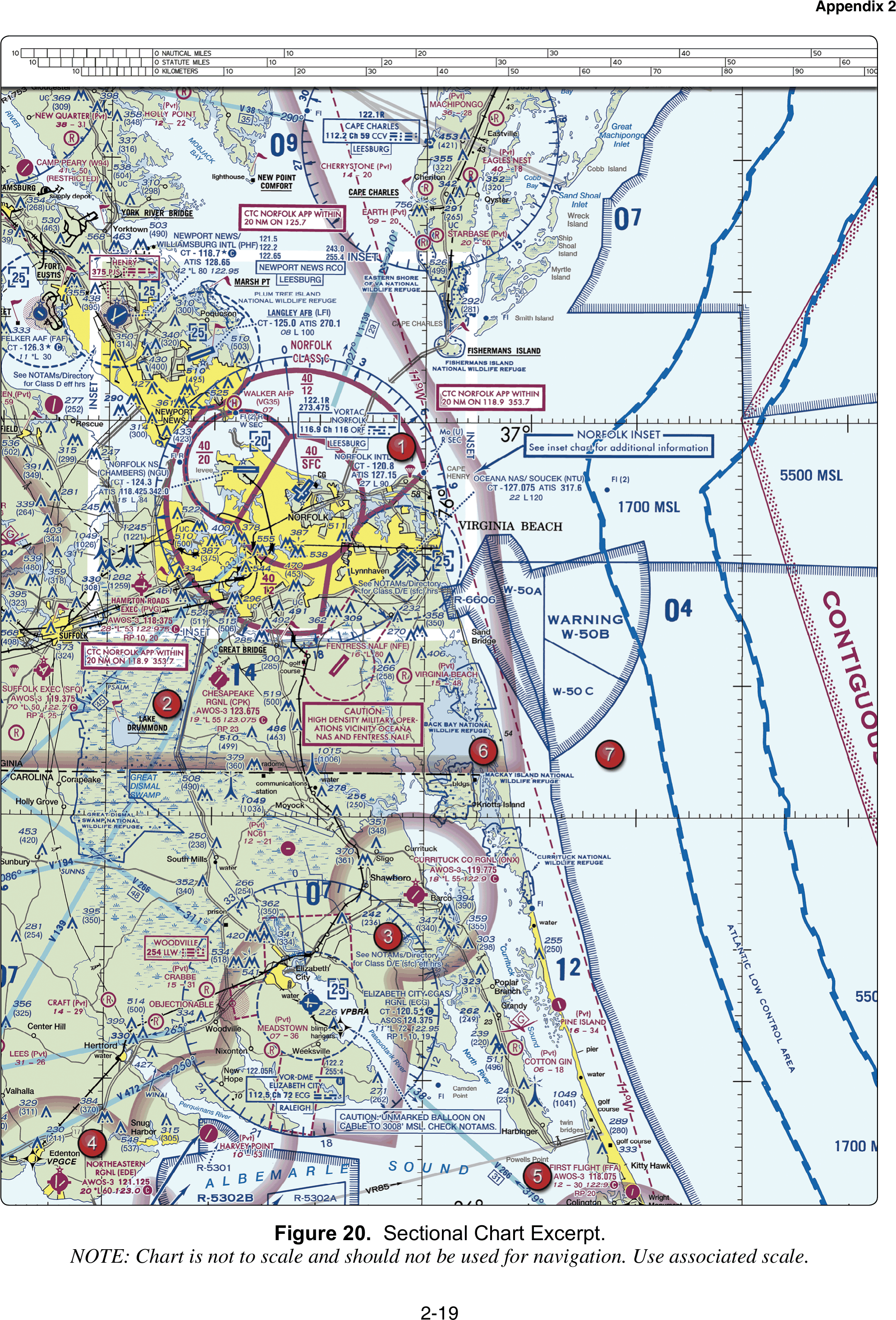
(Refer to FAA-CT-8080-2H, Appendix 2, Figure 20.) The Elizabeth City (ECG) data block ends with the line RP 1, 10, 19. What does that line tell a remote pilot?
- Runways 1, 10 and 19 are the only ones there open to public use
- Runways 1, 10 and 19 are closed and are charted for visual reference
- Manned traffic flies right-hand patterns to runways 1, 10 and 19 ✓
Why: The legend gives RP as runways with right traffic patterns, public use. It matters because the base and final legs for those runways lie on the opposite side of the runway from the usual left-hand pattern, putting low manned traffic where a remote pilot might not think to look.
When must a manned aircraft equipped with an anti-collision light system operate that system?
- During operations in controlled airspace, where other traffic is more likely to be present
- During all types of operations, by day and by night, unless the PIC judges it a hazard to safety ✓
- During night operations only, since by day the lights add nothing to see-and-avoid
Why: Aircraft equipped with an anti-collision light system are required to operate that system during all types of operations, day and night. In adverse meteorological conditions the PIC may determine the lights should be off where their output would be a hazard to safety. AIM 4-3-24, 14 CFR 91.209.
(Refer to FAA-CT-8080-2H, Appendix 2, Figure 20.) East of Elizabeth City an obstruction annotated 1049 (1041) is drawn with a taller symbol than the one annotated 241 (231) beside it, and has short rays radiating from its top. What do the taller symbol and the rays together tell you?
- It stands 1,000 feet or more above the ground and carries high-intensity lights ✓
- It stands 1,000 feet or more above the ground and is still under construction
- It is a group of structures, the tallest of which carries high-intensity lights
Why: The legend draws one symbol for obstructions 1000 ft. and higher AGL and a shorter one for those below 1000 ft. AGL, and shows rays around the symbol for an obstruction with high-intensity lights, which may operate part-time. The parenthesised 1,041 is the height above ground, which is what puts it in the taller class. Under construction would be marked UC, and a group would be drawn as two peaks joined.
What is the difference between a funnel cloud, a tornado and a waterspout?
- A funnel cloud does not reach the surface, a tornado touches land and a waterspout touches water ✓
- A funnel cloud rotates slowly, a tornado rotates fast and a waterspout rotates in either direction
- A funnel cloud forms in the anvil, a tornado forms in the base and a waterspout forms over the sea
Why: The strong winds gather dust and debris and the low pressure generates a funnel-shaped cloud extending downward from the cumulonimbus base. If the cloud does not reach the surface it is a funnel cloud; if it touches a land surface it is a tornado; if it touches water it is a waterspout. PHAK ch.12.
The same Category 2 aircraft is fitted with propellers that are not covered by the remote pilot operating instructions. What follows?
- The aircraft may continue Category 2 operations provided it is relabelled by the operator
- The aircraft is permanently ineligible for any category of operation over human beings
- A new Declaration of Compliance must be submitted before further operations over people ✓
Why: Replacing propellers not covered in the remote pilot operating instructions requires submission of a new DOC to conduct Category 2 or Category 3 operations over people. The operating instructions should list the modifications allowed if eligibility is to be retained.
What limits air traffic control's ability to provide additional services?
- Traffic volume, frequency congestion, radar quality, controller workload and higher priority duties ✓
- The class of airspace alone, since additional services are offered only in Class B and C
- The time of day alone, since additional services are withdrawn outside the published tower hours
Why: The ability to provide additional services is limited by factors such as the volume of traffic, frequency congestion, quality of radar, controller workload, higher priority duties, and the physical inability to scan and detect every situation.
What area does a terminal aerodrome forecast cover?
- A five statute mile radius around the airport for which it is issued ✓
- A ten nautical mile radius around the airport for which it is issued
- The whole of the flight information region in which the airport lies
Why: A TAF is a report established for the five statute mile radius around an airport. TAF reports are usually given for larger airports and are valid for a 24 or 30-hour period.
What are the standard sea level conditions of the International Standard Atmosphere?
- 29.92 inches of mercury and a temperature of 59 degrees Fahrenheit, which is 15 degrees Celsius ✓
- 29.92 inches of mercury and a temperature of 32 degrees Fahrenheit, which is 0 degrees Celsius
- 30.12 inches of mercury and a temperature of 59 degrees Fahrenheit, which is 15 degrees Celsius
Why: To provide a common reference the International Standard Atmosphere has been established, and these standard conditions are the basis for most aircraft performance data. Standard sea level pressure is 29.92 inches of mercury with a standard temperature of 59 degrees Fahrenheit, or 15 Celsius.
Is the person manipulating the controls or a visual observer required to hold an airman medical certificate?
- Yes, both must hold at least a valid third-class airman medical certificate before taking part
- No, and no medical condition disqualifies them provided the remote PIC is medically fit
- No, but they may not take part if they know of a condition that could interfere with safe operation ✓
Why: The person manipulating the controls and the visual observer are not required to obtain an airman medical certificate, but they cannot participate if they know or have reason to know they have a physical or mental condition that could interfere with safe operation. 14 CFR 107.17.
For a standard remote identification aircraft to be operated, its serial number must be
- listed on an FAA-accepted declaration of compliance, or part 21 approved ✓
- marked on the exterior of the airframe in letters at least 3 mm high
- registered with the community-based organization overseeing the site
Why: The aircraft may be operated only if its serial number is listed on an FAA-accepted declaration of compliance, or it is covered by a design or production approval issued under part 21 and meets subpart F. Its remote ID equipment must also be functional. 14 CFR 89.110(b)(1).
A temporary remote pilot certificate is issued for a period of up to
- 120 calendar days ✓
- 60 calendar days
- 24 calendar months
Why: A temporary remote pilot certificate with a small UAS rating is issued for up to 120 calendar days, after which a permanent certificate is issued to a person the Administrator finds qualified. 14 CFR 107.64(a).
During an automated flight sequence the remote PIC must
- remain able to direct the aircraft to ensure compliance with the rules ✓
- transfer responsibility for compliance to the flight-planning software
- stay within 50 feet of the control station until the sequence ends
Why: Automation does not transfer responsibility. The remote pilot in command must have the ability to direct the small unmanned aircraft to ensure compliance with the applicable provisions of the chapter, and remains the final authority. 14 CFR 107.19(e).
What is a front?
- The leading edge of a thunderstorm's outflow, marked at the surface by the first gust
- The boundary between the troposphere and the stratosphere, where temperature stops falling
- The zone between two air masses of different properties, across which conditions change rapidly ✓
Why: As air masses move out of their source regions they come into contact with other air masses of different properties. The zone between two different air masses is a frontal zone or front, and across this zone temperature, humidity and wind often change rapidly over short distances.
(Refer to FAA-CT-8080-2H, Appendix 2, Figure 20.) A second CAUTION box on this chart warns of what hazard in the vicinity of Oceana NAS and Fentress NALF?
- Unmarked balloons on cables
- Uncharted antenna towers over 1,000 feet AGL
- High density military operations ✓
Why: The box reads CAUTION: HIGH DENSITY MILITARY OPERATIONS VICINITY OCEANA NAS AND FENTRESS NALF. A caution box states its hazard in plain words, which is why reading the box itself is the whole of the task.
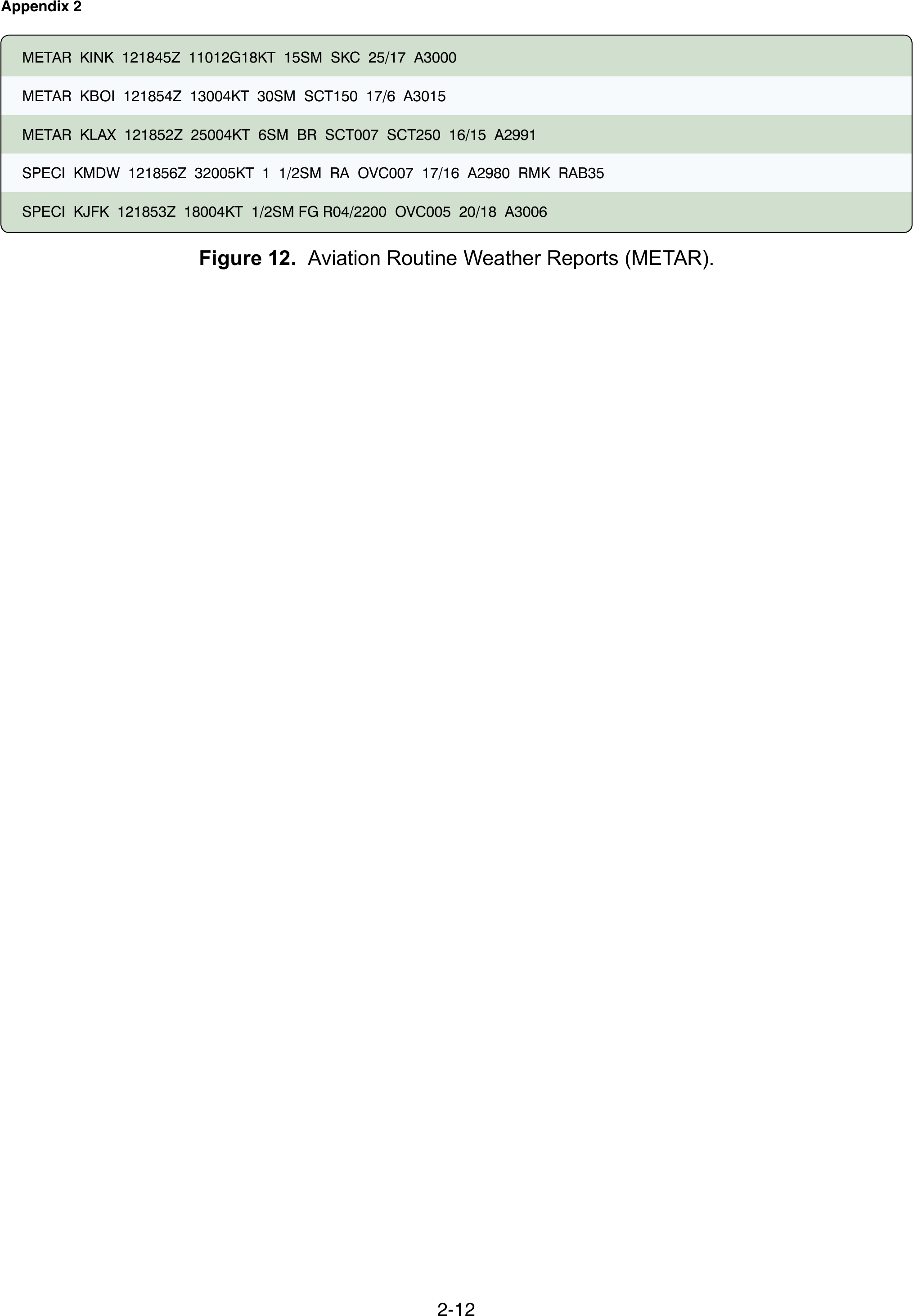
(Refer to FAA-CT-8080-2H, Appendix 2, Figure 12.) Which two of the five reports shown are special reports rather than routine ones?
- The KINK and KBOI reports, each of which begins with METAR
- The KLAX and KMDW reports, which are the two showing precipitation
- The KMDW and KJFK reports, each of which begins with SPECI ✓
Why: A routine report begins with METAR and is transmitted on a regular time interval. A SPECI is a special report issued at any time between routine reports to cover rapidly changing conditions. Here KMDW and KJFK are the SPECI reports.
What causes precipitation static?
- An aircraft in flight passing close to a lightning discharge, which induces a current in the airframe
- An aircraft in flight accumulating ice, which insulates the static wicks from the airstream
- An aircraft in flight striking uncharged particles, which leaves a negative charge on the skin ✓
Why: Precipitation static is caused by an aircraft in flight coming into contact with uncharged particles such as rain, snow, fog, sleet, hail, volcanic ash or dust. The positive element is reflected away and the negative adheres to the skin, building a substantial negative charge. AIM 7-6-12.
How long should a pilot wait after the first dose of any new medication before flying?
- At least 12 hours, or until the medication's stated half-life has fully elapsed
- At least 48 hours, to establish that there are no adverse side effects ✓
- At least 8 hours, which is the same interval that applies after drinking alcohol
Why: For any new medication, whether over-the-counter or prescribed, a pilot should wait at least 48 hours after the first dose before flying, to determine there are no adverse side effects that would make it unsafe to operate an aircraft.
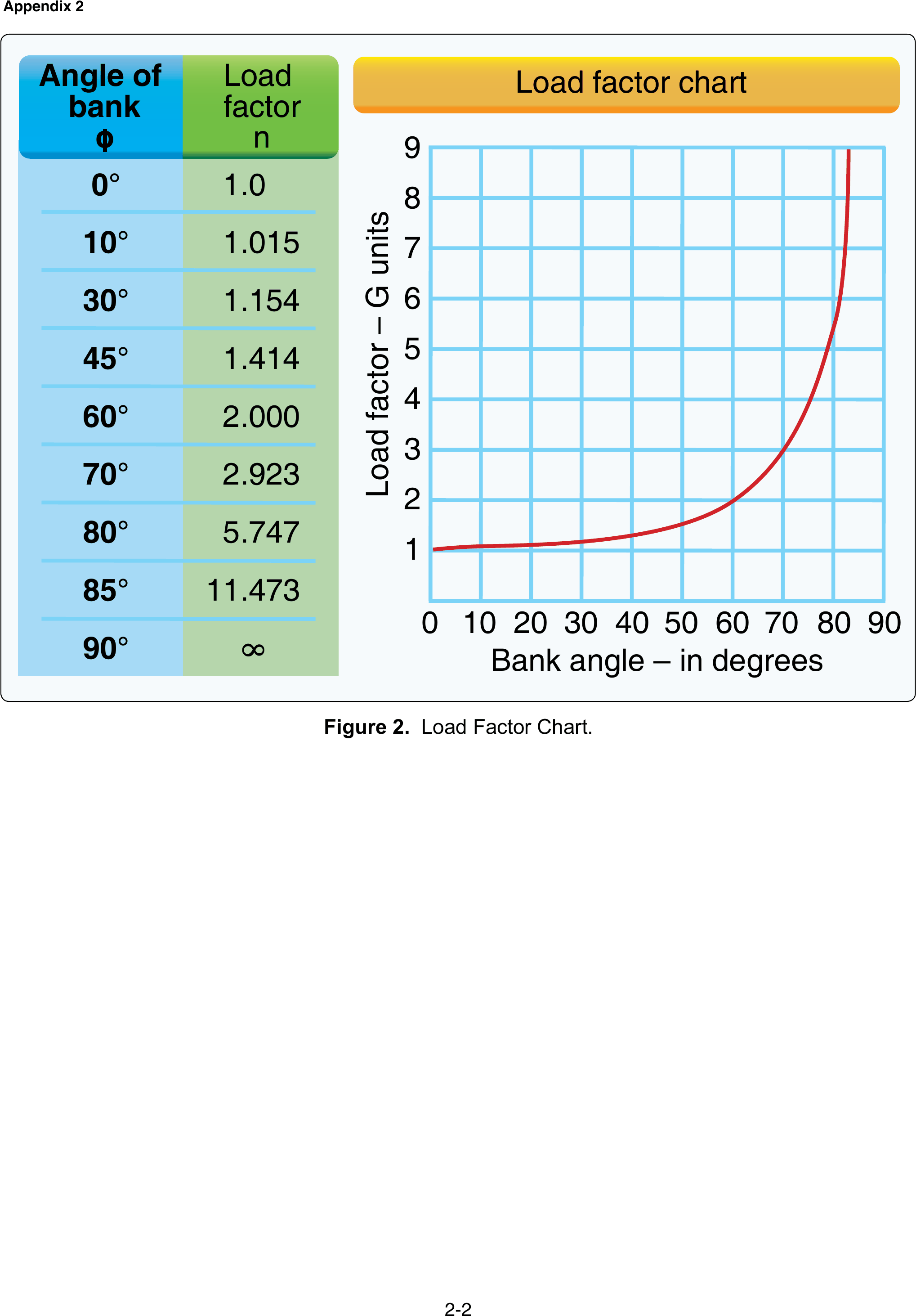
(Refer to FAA-CT-8080-2H, Appendix 2, Figure 2.) A small unmanned aircraft weighing 20 pounds is flown in a 45-degree banked level turn. What load does the structure carry?
- About 20 pounds, since a level turn does not change the load
- About 40 pounds, from a load factor of 2.000
- About 28 pounds, from a load factor of 1.414 ✓
Why: The chart gives 1.414 at 45 degrees of bank, so 20 x 1.414 = 28.3 pounds. The load factor of 2.000 belongs to a 60-degree bank, and a level turn always raises the load above 1 G because the wing must produce more lift than weight to turn and hold altitude.
(Refer to FAA-CT-8080-2H, Appendix 2, Figure 12.) Which of the five airports reports the best prevailing visibility?
- KINK, at 15 statute miles
- KLAX, at 6 statute miles
- KBOI, at 30 statute miles ✓
Why: Prevailing visibility is reported in statute miles denoted SM. The five reports give 15SM at KINK, 30SM at KBOI, 6SM at KLAX, 1 1/2SM at KMDW and 1/2SM at KJFK, so KBOI has the best.
You believe another aircraft is too close. What does the AIM advise?
- Hold your present course and heading, since altering it would confuse the other pilot's avoidance action
- Transmit an advisory on the common frequency and await the other pilot's acknowledgement
- Give way rather than waiting for the other pilot to respect a right of way you may be entitled to ✓
Why: If you think another aircraft is too close to you, give way instead of waiting for the other pilot to respect the right-of-way to which you may be entitled. It is a lot safer to pursue the right-of-way angle after you have completed your flight. AIM 7-6-1.
A remote pilot who has flown 16 hours is asked whether they are too tired to continue. Why is that self-assessment unreliable?
- Because fatigue cannot be perceived at all until the pilot has been awake for 24 hours or more
- Because the regulations set no duty-time limit, so the pilot has no benchmark to measure against
- Because the pilot acts as their own quality control, and goal-oriented pilots tend to deny personal limits ✓
Why: For the single pilot, assessing risk is not simple because the pilot acts as their own quality control. Most pilots are goal oriented, and when asked to accept a flight there is a tendency to deny personal limitations while adding weight to issues not germane to the mission.
Within what period must a remote pilot have satisfied the aeronautical knowledge recency requirement?
- The previous 24 calendar months, counted from the date the privileges are exercised ✓
- The previous 12 calendar months, counted from the date the privileges are exercised
- The previous 36 calendar months, counted from the date the certificate was first issued
Why: A person may not exercise the privileges of a remote pilot in command with a small UAS rating unless that person has accomplished one of the listed items, in a manner acceptable to the Administrator, within the previous 24 calendar months. 14 CFR 107.65.
A remote pilot sees an aircraft's landing light below 10,000 feet in daylight near an airport. Why is it on?
- Operation Lights On, a voluntary FAA programme encouraging landing lights to enhance see-and-avoid ✓
- A regulatory requirement that landing lights be used below 10,000 feet within 10 miles of an airport
- An indication that the aircraft has declared an emergency and requires priority handling
Why: The FAA has a voluntary pilot safety programme, Operation Lights On, to enhance see-and-avoid. Pilots are encouraged to turn on landing lights during takeoff and when operating below 10,000 feet day or night, especially within 10 miles of an airport or where flocks of birds may be expected. AIM 4-3-24.
What is a false horizon?
- A misleading horizon reference caused by the aircraft's own attitude indicator losing its erection
- A misleading horizon reference produced by staring at a single point of light in the dark
- A misleading horizon reference generated by an obscured true horizon, bright stars or city lights ✓
Why: A false horizon can occur when the natural horizon is obscured or not readily apparent. It can be generated by confusing bright stars and city lights, and can also occur while flying toward the shore of an ocean or a large lake. PHAK ch.17.
How much water should be drunk to help prevent dehydration?
- One quart every 24 hours, which is the minimum the body can absorb in that period
- Eight quarts every 24 hours, which replaces the fluid lost through normal respiration alone
- Two to four quarts every 24 hours, taken as a guide rather than as a fixed requirement ✓
Why: To help prevent dehydration, drink two to four quarts of water every 24 hours. Since each person is physiologically different this is only a guide. The often-quoted eight glasses a day equates to 64 ounces, which is two quarts.
An aircraft approaching a runway sees two solid yellow lines then two dashed ones. What must it do?
- Continue on without stopping, since the solid lines face only aircraft leaving the runway
- Stop before the first solid line and not cross the double solid lines without an ATC clearance ✓
- Cross the solid lines and stop between them and the dashed lines to await a clearance
Why: As you approach the runway, two solid yellow lines and two dashed lines are visible. Prior to reaching the solid lines it is imperative to stop and ensure no part of the aircraft intersects the first solid yellow line. Do not cross the double solid lines without an ATC clearance. PHAK ch.14.
What is situational awareness?
- The ability to recall the aircraft's position at any moment from the control station display
- The practice of briefing every participant on their role before the operation begins
- The accurate perception and understanding of all the factors and conditions affecting safety ✓
Why: Situational awareness is the accurate perception and understanding of all the factors and conditions within the five fundamental risk elements that affect safety before, during and after the flight. It requires understanding the significance of each factor and its future impact.
How does air density vary with pressure, at a constant temperature?
- Density is directly proportional to pressure, so halving the pressure halves the density ✓
- Density is inversely proportional to pressure, so halving the pressure doubles the density
- Density is independent of pressure, since only temperature and humidity change it
Why: Density is directly proportional to pressure. If the pressure is doubled the density is doubled, and if the pressure is lowered so is the density. This statement is true only at a constant temperature.
What is wind shear?
- A steady increase in wind speed with height above the surface of the ground
- A reversal of the prevailing wind that follows the passage of a warm front
- A sudden, drastic change in wind speed or direction over a very small area ✓
Why: Wind shear is a sudden, drastic change in wind speed and/or direction over a very small area. It can subject an aircraft to violent updrafts and downdrafts as well as abrupt changes to its horizontal movement, and it can occur at any altitude.
A small unmanned aircraft strikes a parked car, causing damage the owner's garage quotes at $900 to repair. Within what period must the remote PIC report this to the FAA?
- Within 10 calendar days of the operation ✓
- Within 72 hours of the operation
- Within 24 hours of the operation
Why: A safety event must be reported no later than 10 calendar days after the operation. Property damage is reportable unless the repair cost is $500 or less, or the property's fair market value is $500 or less in the case of total loss. $900 exceeds that threshold. 14 CFR 107.9.
After deviating from a part 107 rule to respond to an in-flight emergency, what must the remote pilot in command do?
- Send the FAA a written report explaining the deviation before conducting any further flights
- Send the FAA a written report explaining the deviation, but only if the FAA requests one ✓
- Send the FAA a written report explaining the deviation within 10 calendar days of the flight
Why: A remote PIC who exercises this emergency power is required, upon request of the Administrator, to send a written report of that deviation to the FAA. The report is not automatic; it is triggered by an FAA request. 14 CFR 107.21.
Within what distance of a runway do found wildlife remains count as an identified strike?
- Within 250 feet of a runway centreline, or within 1,000 feet of a runway end ✓
- Within 500 feet of a runway centreline, or within 2,000 feet of a runway end
- Within 100 feet of a runway centreline, or within 500 feet of a runway end
Why: A wildlife strike is identified where remains are found within 250 feet of a runway centreline or within 1,000 feet of a runway end, unless another reason for the animal's death is identified or suspected. AC 150/5200-32C.
Can an aircraft always be flown safely at its specified maximum gross takeoff weight?
- Yes, provided the centre of gravity has been confirmed to lie within the published limits
- No, because conditions such as high elevation, heat and humidity may require a weight reduction ✓
- Yes, because the maximum gross takeoff weight already allows for every likely operating condition
Why: Although a maximum gross takeoff weight may be specified, the aircraft may not always safely take off with that load under all conditions. High elevations, high air temperatures and high humidity, all of which mean high density altitude, may require a reduction in weight before flight.
What effect does an insufficient intake of vitamin A have on night vision?
- A lack of it has no effect at all, though high quantities do improve night vision
- A lack of it causes the rods to adapt faster but with reduced acuity
- A lack of it impairs night vision, though high quantities do not improve it ✓
Why: An insufficient consumption of vitamin A may impair night vision. Foods high in vitamin A include eggs, butter, cheese, liver, apricots, carrots and most greens. High quantities of vitamin A do not increase night vision, but a lack of vitamin A certainly impairs it. PHAK ch.17.
Is the size of a stack or cooling tower a good indicator of the effect its plume will produce?
- Yes, a taller stack produces a proportionally larger and considerably more turbulent plume overall
- Yes, but only where the plume is visible as smoke or as a condensation cloud
- No, the major effects relate to the heat or size of the effluent, the air temperature and the wind speed ✓
Why: The size of the tower or stack is not a good indicator of the predicted effect the plume may produce. The major effects are related to the heat or size of the plume effluent, the ambient air temperature, and the wind speed affecting the plume. AIM 7-6-16.
(Refer to FAA-CT-8080-2H, Appendix 2, Figure 12.) What is the reported altimeter setting at KLAX?
- 2,991 feet of pressure altitude, from the group A2991
- 991 millibars, from the group A2991
- 29.91 inches of mercury, from the group A2991 ✓
Why: The altimeter setting is reported as inches of mercury in a four-digit group preceded by the letter A, so A2991 is 29.91 inches. The four other reports give A3000, A3015, A2980 and A3006 in the same form.
What should a remote pilot do if no manufacturer-published performance data is available?
- Apply the standard performance figures published in the Chart Supplement U.S.
- Seek out data already determined and published by other users of the same model, as a starting point ✓
- Assume the aircraft performs to the operating limits set out in 14 CFR part 107 subpart B
Why: Manufacturers' information regarding performance data is not standardised. If manufacturer-published performance data is unavailable, it is advisable to seek out performance data already determined and published by other users of the same small UA manufacturer model and use it as a starting point.
Registration of a civil small unmanned aircraft system used under part 107 is
- optional if the aircraft is flown only over private property
- required, in accordance with 14 CFR 91.203(a)(2) ✓
- required only if the aircraft weighs more than 0.55 pounds and is flown commercially
Why: Part 107 requires a person operating a civil small UAS for flight to comply with the registration provisions of 14 CFR 91.203(a)(2). There is no exception for private property. 14 CFR 107.13.
What practical benefit does the FAA attribute to maintenance recordkeeping?
- It transfers responsibility for the aircraft's condition to the maintenance provider
- It helps track component service life and reveals systemic failure patterns over time ✓
- It satisfies the part 107 requirement for an annual inspection of the small UAS
Why: Methodical maintenance and inspection data collection can prove very helpful in tracking small UAS component service life, as well as systemic component, equipage and structural failure events. It also reinforces owner and operator responsibility.
What is the remote pilot in command's responsibility regarding the condition of the aircraft before flight?
- To ensure the aircraft has been inspected and signed off by an FAA-certificated mechanic within the last 12 calendar months
- To ensure the aircraft has logged fewer flight hours than the manufacturer's stated service life
- To ensure the aircraft is in a safe operating condition and that any irregularity found is corrected first ✓
Why: A remote pilot is responsible for the safe operation of the small UA at all times and must ensure the aircraft is in a safe operating condition before flight. If any irregularities are found in the preflight inspection, they must be corrected before the aircraft is operated.
What must a request for a certificate of waiver contain?
- A complete list of the crew members with their remote pilot certificate numbers and their issue dates
- A complete description of the proposed operation and a justification that it can be conducted safely ✓
- A complete maintenance history of the aircraft and the results of its most recent inspection
Why: A request for a certificate of waiver must contain a complete description of the proposed operation and justification that establishes that the operation can safely be conducted under the terms of a certificate of waiver. 14 CFR 107.200(b).
What is controlled airspace?
- A generic term for airspace that lies within the lateral limits of a Mode C veil
- A generic term for the classifications and dimensions within which ATC service is provided ✓
- A generic term for any airspace in which a remote pilot must hold a valid certificate of waiver
Why: Controlled airspace is a generic term that covers the different classifications of airspace and defined dimensions within which air traffic control service is provided in accordance with the airspace classification. The classes of concern to a remote pilot are B, C, D and E.
Whose responsibility is it to check that an aircraft is listed on an FAA-accepted Declaration of Compliance?
- The remote pilot's, who can check online and must also confirm the aircraft is labelled correctly ✓
- The manufacturer's, who must notify each owner whenever a declaration is accepted or withdrawn
- The FAA's, which issues each eligible aircraft with a numbered certificate of compliance
Why: It is the remote pilot's responsibility to ensure the small unmanned aircraft is listed on an FAA-accepted Declaration of Compliance as eligible for the category of operation and is labelled as eligible. This can be checked online at the FAA's declaration of compliance site.
A conviction for a State offence involving the possession of narcotic drugs is grounds for
- a mandatory suspension of the certificate for 30 days
- denial of an application for up to 1 year, or suspension or revocation ✓
- no certificate action, the offence being unconnected with aviation
Why: Such a conviction is grounds for denial of an application for a remote pilot certificate for up to 1 year after the date of final conviction, or for suspension or revocation of a certificate already held. 14 CFR 107.57(a).
What are the minimum cloud clearances for a small unmanned aircraft under part 107?
- 1,000 feet above and 500 feet below
- 500 feet below and 1,000 feet horizontally
- 500 feet below and 2,000 feet horizontally ✓
Why: The aircraft must remain at least 500 feet below the cloud and 2,000 feet horizontally from the cloud. 14 CFR 107.51(d).
What class of airspace does the primary airport within a terminal radar service area have?
- Class C, with the remainder of the TRSA overlying uncontrolled Class G airspace
- Class B, with the remainder of the TRSA overlying other controlled airspace, normally Class D
- Class D, with the remainder of the TRSA overlying other controlled airspace, normally Class E ✓
Why: The primary airports within a TRSA become Class D airspace. The remaining portion of the TRSA overlies other controlled airspace, normally Class E beginning at 700 or 1,200 feet, established to transition to and from the en route or terminal environment.
Where should the modifications that keep an aircraft eligible be listed?
- In the declaration of compliance itself, which is amended each time a part is replaced
- In the remote pilot operating instructions, which should set out the allowable modifications ✓
- In the aircraft's maintenance logbook, which the remote pilot must carry during operations
Why: An applicant should specify allowable modifications in the remote pilot operating instructions. Those instructions should include a list of allowed modifications for the small unmanned aircraft to remain eligible. AC 107-2A 8.4.4 and 8.4.5.
What is autokinesis?
- A stationary light appearing to move when stared at against a dark background ✓
- A stationary light appearing to change colour when viewed through peripheral vision
- A moving light appearing to remain stationary when the observer is also moving
Why: Autokinesis is caused by staring at a single point of light against a dark background for more than a few seconds. After a few moments the light appears to move on its own. Apparent movement begins in about 8 to 10 seconds. PHAK ch.17.
How does an airliner normally construct its radio call sign?
- From the aircraft model followed by the flight number, as in Boeing Seven-One-One
- From the company name followed by the flight number, as in Southwest Seven-One-One ✓
- From the company name followed by the registration number, as in Southwest One-Two-Three-Alpha
Why: Airliners typically use the name of their company and their flight number, so Southwest Airlines flight 711 is spoken as Southwest Seven-One-One. A few carriers use a different telephony designator, such as British Airways using Speedbird.
Which preflight item applies specifically to flight during civil twilight or at night?
- Checking that the anti-collision light is functioning before the flight begins ✓
- Checking that the aircraft's registration markings are illuminated from below
- Checking that the control station display has been dimmed to preserve night vision
Why: The recommended preflight items include checking that the anti-collision light is functioning if operating during civil twilight or at night. That check is specific to those operations; it is not required for a daytime flight.
What happens when a restricted area is not active and has been released to the FAA?
- The ATC facility issues a clearance that ensures the aircraft avoids that restricted airspace entirely
- The restricted area is removed from the chart until the using agency reactivates it
- The ATC facility allows aircraft to operate in it without issuing a specific clearance to do so ✓
Why: If the restricted area is not active and has been released to the FAA, the ATC facility allows the aircraft to operate in the restricted airspace without issuing specific clearance. If it is active and has not been released, ATC issues a clearance that ensures the aircraft avoids it.
Is a manned pilot required by regulation to make radio broadcasts in the vicinity of a non-towered airport?
- No, it is good operating practice but it is not mandatory, so a remote pilot must still scan visually ✓
- Yes, every aircraft within 10 miles of a non-towered airport must broadcast its position and intentions
- No, but any aircraft not broadcasting must first obtain a deviation from its flight service station
Why: Radio broadcasts near a non-towered airport are good operating practice but are not required by regulation. Some aircraft have no radio at all, so a remote pilot must always scan the area visually and treat the radio as an extra layer of situational awareness.
What does a runway holding position sign look like, and what does it mean?
- Black characters on a yellow background; it marks the boundary of the runway safety area
- White numbers on a black background; it gives the runway distance remaining in thousands of feet
- White characters outlined in black on a red background; it is the airport version of a stop sign ✓
Why: A runway holding position sign is an airport version of a stop sign. It has white characters outlined in black on a red background, is always collocated with surface painted holding position markings, and is located where taxiways intersect runways. PHAK ch.14.
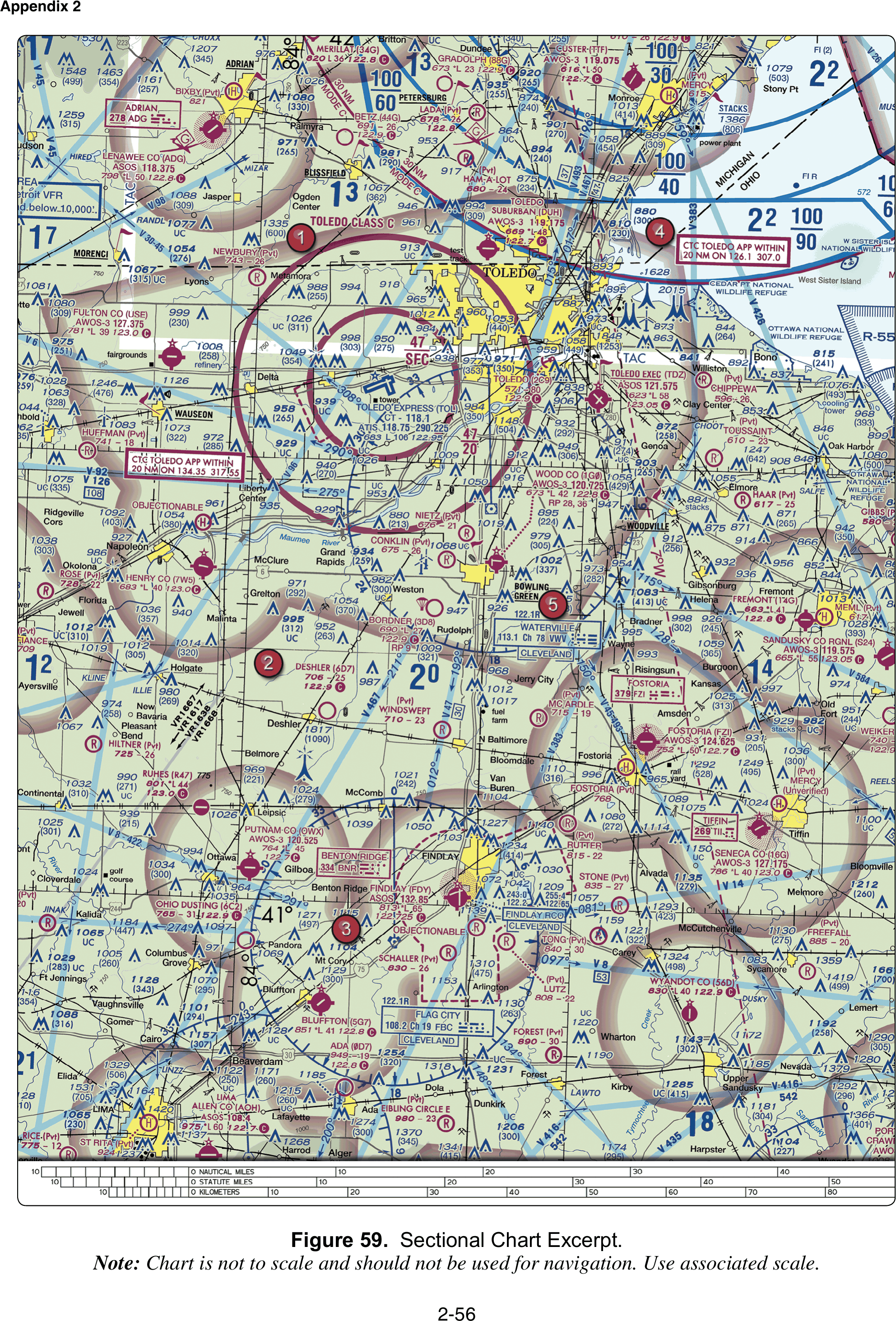
(Refer to FAA-CT-8080-2H, Appendix 2, Figure 59.) Findlay (FDY) is enclosed by a dashed magenta line. What does that line depict?
- A Class E surface area designated for that airport ✓
- A Class D airspace around an airport with a part-time tower
- An area where fixed-wing special VFR flight is prohibited
Why: The legend gives a dashed magenta line as Class E (sfc) Airspace. It is drawn magenta and dashed precisely because there is no tower there - a Class D boundary is drawn dashed in blue, and Findlay's data block carries no CT frequency.
At roughly what bank angle does the load factor begin to increase at a terrific rate?
- After a bank has reached about 15 to 20 degrees
- After a bank has reached about 75 to 80 degrees
- After a bank has reached about 45 to 50 degrees ✓
Why: The load factor increases at a terrific rate after a bank has reached 45 or 50 degrees. The line denoting load factor rises rapidly as it approaches the 90 degree bank line, which it never quite reaches because a 90 degree banked constant altitude turn is not mathematically possible.
Are two-way radio communications required to operate at a non-towered airport?
- Yes, every aircraft in the traffic pattern must transmit position reports on the CTAF
- No, but a remote pilot must obtain a radio waiver from the FAA before operating nearby
- No, they are not required, though monitoring the common frequency is good practice ✓
Why: A non-towered airport has no operating control tower and two-way radio communications are not required there. It remains good operating practice for pilots to monitor the specified common frequency for the benefit of other traffic in the area.
Under the rules part 107 adopts, a person may not act as remote PIC within how long of consuming an alcoholic drink?
- 8 hours ✓
- 12 hours
- 24 hours
Why: Part 107 requires compliance with 14 CFR 91.17, under which a person may not act as a crewmember within 8 hours of consuming any alcoholic beverage, while under the influence, with a blood alcohol concentration of .04 percent or greater, or while using an impairing drug. AC 107-2A ch.5.
(Refer to FAA-CT-8080-2H, Appendix 2, Figure 20.) Boxes on this chart read CTC NORFOLK APP WITHIN 20 NM ON 125.7 and CTC NORFOLK APP WITHIN 20 NM ON 118.9 353.7. What are these?
- The common traffic advisory frequencies for the airports inside that radius
- The emergency frequencies reserved for aircraft experiencing a failure in that area
- The approach control frequencies to contact within 20 NM of the associated airspace ✓
Why: A CTC box gives the approach control facility to contact and the frequency to use within the stated distance. Two frequencies are shown for Norfolk Approach because the airspace is divided by sector; 353.7 is the military UHF frequency paired with the civil VHF one.
An aircraft is eligible for Category 2 in one configuration and Category 3 in another. What does the remote pilot need to establish before an operation over people?
- Which configuration the manufacturer prefers, and that it was the one used on the preceding flight
- Which configuration gives the longer endurance, since that determines the permitted category
- Which configuration the aircraft is currently in, and that the category matches the intended operation ✓
Why: Eligibility for more than one category is permitted so long as the remote PIC cannot inadvertently switch between modes. The operating instructions must describe how to verify the current mode, so the pilot can confirm the aircraft is in the configuration the intended operation requires.
What limits the amount of lift an airfoil can produce?
- The propeller diameter, the motor's rated power and the control station's range
- The airfoil's design, the angle of attack, the airspeed and the density of the air ✓
- The aircraft's registered weight, its rated payload capacity and its battery endurance
Why: The amount of lift produced by an airfoil is limited by the airfoil design, angle of attack, airspeed and air density. To ensure the lift generated is sufficient to counteract weight, loading beyond the manufacturer's recommended weight must be avoided.
(Refer to FAA-CT-8080-2H, Appendix 2, Figure 22.) A note beside Coeur D'Alene reads See NOTAMs/Directory for Class E (sfc) eff hrs. What does it tell a remote pilot?
- The Class E surface area there may be entered at any hour without an ATC authorisation
- The Class E surface area there is in effect only at certain hours, which are published elsewhere ✓
- The Class E surface area there has been withdrawn and the chart has not yet been revised
Why: The note points to the NOTAMs and the Chart Supplement for the hours during which that surface area is effective, because they are not fixed on the chart. Whether an ATC authorisation is needed therefore depends on the time of the operation as well as the place.
A remote pilot relies on the aircraft's GPS to hold altitude below 400 feet AGL. What is the consequence if the GPS signal is lost in flight?
- The aircraft will immediately return to its launch point and land without any pilot input
- The aircraft may exceed 400 feet AGL lawfully, because the limit applies only to GPS-equipped aircraft
- The altitude reference is lost, so the pilot must fall back on another means of judging height ✓
Why: Installing a GPS device that reports MSL altitude is one listed way of complying with the altitude limit, but it is not the only one. If GPS is lost the pilot must use another method, such as pacing off 400 feet on the ground beforehand or using known terrain and structure heights.
What are the phonetic words for the letters J, Q and V?
- Jupiter, Quebec and Vector
- Juliett, Quebec and Victor ✓
- Juliet, Quantum and Viking
Why: The ICAO phonetic alphabet gives Juliett for J, Quebec for Q and Victor for V. AIM Table 4-2-2 carries the full alphabet with the approved pronunciations.
(Refer to FAA-CT-8080-2H, Appendix 2, Figure 20.) At Elizabeth City (ECG) the data block reads CT - 120.5 followed by a star and then a circled C. What do those two markings together tell you?
- 120.5 is both the tower frequency and the CTAF, and the tower operates continuously
- 120.5 is the tower frequency for arrivals only, and departures use 122.95 instead
- 120.5 is both the tower frequency and the CTAF, and the tower operates part time ✓
Why: The legend gives CT as the control tower primary frequency, the star as indicating part-time operation with hours in the tower frequencies tabulation, and the circled C as a common traffic advisory frequency. When the tower is closed the field reverts to self-announce on that same 120.5. The 122.95 at the end of the line below is the UNICOM.
Why might a newly erected antenna tower not appear on a current sectional chart?
- Because towers of less than 1,000 feet AGL go unrecorded, regardless of when they were built
- Because towers are only charted once they have been fitted with obstruction lighting
- Because the information arrived too late for that printing, and charts are revised semiannually ✓
Why: New towers may not be on a current chart because the information was not received prior to the printing of the chart. Extreme caution should be exercised when flying below 2,000 feet AGL, where numerous skeletal structures exceed 1,000 feet AGL.
Under 14 CFR part 107, what is the maximum weight of a small unmanned aircraft at takeoff?
- Less than 55 pounds, including everything on board or attached ✓
- Less than 55 pounds, excluding payload and attached equipment
- Less than 25 kilograms, excluding batteries and camera gear
Why: Part 107 defines a small unmanned aircraft as one weighing less than 55 pounds on takeoff, including everything that is on board or otherwise attached to the aircraft. Payload and batteries count toward the limit. 14 CFR 107.3.
What effect does an increase in altitude have on climb performance?
- It has no effect on climb performance until the aircraft's absolute ceiling is reached
- It increases the power required and decreases the power available, so climb performance diminishes ✓
- It decreases the power required and increases the power available, so climb performance improves
Why: Climb performance depends directly on the ability to produce excess thrust or excess power. An increase in altitude increases the power required and decreases the power available, so the climb performance of an aircraft diminishes with altitude.