FAA Mechanic Airframe (AMA) Knowledge Test, Practice Exams
Revision Mode
Revise with instant feedback: the moment you pick an answer you see whether it was right, with the handbook-cited explanation. Untimed — ideal before you sit a mock test. Questions you miss keep coming back until you know them.
Exam Mode
Test-day conditions: no feedback until you submit, each knowledge area scored separately, with a full question-by-question review at the end.
The real test requires 70% to pass. Each knowledge area is scored separately here so you know exactly where you stand.
Knowledge areas & your progress
Unlock the full question bank
The free sample gives you about two exams' worth of questions per knowledge area. The full bank covers every knowledge area in depth, with source-cited explanations. $49, one time, lifetime access on up to 3 devices — all five tests (Mechanic General, Airframe, Powerplant, Part 107 Remote Pilot, and Inspection Authorization) included.
✓ One purchase, every written test · up to 3 devices · no subscription · no account needed
Score history
Reviews
Review
Frequently asked questions
How is the FAA Mechanic Airframe (AMA) Knowledge Test structured?
The real Aviation Mechanic - Airframe written test has 100 multiple-choice questions (3 options each), a 2-hour time limit, and requires 70% to pass. Questions are drawn across 15 knowledge areas. These follow the FAA-S-ACS-1 blueprint, and this bank mirrors those areas and their weights.
What score do I need to pass?
70 percent. Revise each knowledge area to that level in Revision Mode, then run the full exam simulation in Exam Mode before your test date.
Are these real FAA exam questions?
The live test bank is not published. Our questions include the FAA's own published sample questions plus original questions written to the FAA-S-ACS-1 blueprint and grounded in the FAA handbooks (FAA-H-8083-30B, 31B and 32B) and 14 CFR, with the source cited in each explanation.
How many practice questions are included?
The full Aviation Mechanic - Airframe bank contains 549 questions with explanations. The free sample gives you roughly two exams' worth per knowledge area.
Do I need all three mechanic tests?
A full A&P certificate requires General, Airframe, and Powerplant written tests (plus oral & practical). One Hangar Prep purchase covers every test on the site, for life.
What does access cost?
$49, one time, for lifetime access to every test on the site and everything we add later. No subscription.
Can I use it on more than one device?
Yes. One purchase works on up to 3 of your devices. Your progress is saved on each device.
Do I need to create an account?
No. The practice tests run in your browser with no signup. Your score history is saved on your own device.
What topics does the FAA Mechanic Airframe (AMA) Knowledge Test question bank cover?
It is organised into 15 modules that follow the exam's own content areas: Metallic Structures, Non-Metallic Structures, Flight Controls, Airframe Inspection, Landing Gear Systems, Hydraulic and Pneumatic Systems, Environmental Systems, Aircraft Instrument Systems, Communication, Light Signals, and Runway Lighting Systems, Aircraft Fuel Systems, Aircraft Electrical Systems, Ice and Rain Control Systems, Airframe Fire Protection Systems, Rotorcraft Fundamentals and Water and Waste Systems. Each module is drilled and scored separately, so you can see exactly which areas are exam-ready and which still need work.
When was this question bank last updated?
Last updated 6 July 2026. The bank is revised whenever the source material it cites changes, and every question carries the source its explanation is drawn from.
Sample FAA Mechanic Airframe (AMA) Knowledge Test practice questions
A selection of free questions with answers and explanations. Use the interactive modules above for timed, scored drills.
A magnetic compass is 'swung' on what, and a deviation card is completed for what purpose?
- On a compass rose; the card records the residual deviation on each heading for the pilot ✓
- On a level workbench; the card records the instrument's serial number
- In flight only; the card records the aircraft's variation for that region
Why: The compass is swung on a compass rose (away from magnetic interference); after compensating, a deviation (correction) card is filled out showing the residual deviation on each heading. FAA-H-8083-31B ch.10.
Where is the main fuel strainer (gascolator) typically located, and what feature does it include?
- Downstream of the selector valve at a low point, with a drain to remove water and sediment from the sump ✓
- Upstream of the fuel tank vents, with no drain provision
- Inside the engine cylinder head, with an automatic bypass per the applicable maintenance manual
Why: The main fuel strainer/gascolator is located downstream of the selector valve, usually at a low point, and includes a sediment bowl and drain so water and sediment can be removed from the sump. FAA-H-8083-31B ch.14.
On an aircraft instrument, what does a red radial line indicate?
- A maximum or minimum limit that must not be exceeded (a 'never exceed' value) ✓
- The normal operating range of the instrument per the applicable maintenance manual
- A precautionary (caution) range of operation
Why: A red radial line marks a limit not to be exceeded (maximum or minimum), such as never-exceed speed; the green arc is the normal range and the yellow arc is the caution/precautionary range. FAA-H-8083-31B ch.10.
Show more sample questions with answers & explanations
A key part of anti-ice/de-ice system maintenance for a thermal (bleed air) system is checking what?
- Ducts and valves for leaks and correct operation, since a leak or stuck valve can cause overheat or failure to anti-ice ✓
- The specific gravity of the boot rubber per the applicable maintenance manual according to the manufacturer's service data
- The rain repellent reservoir level
Why: Thermal anti-ice maintenance includes inspecting the bleed air ducts and control valves for leaks and proper operation; a leak or a stuck valve can overheat structure or leave a surface unprotected. FAA-H-8083-31B ch.15.
How is the correct fluid level/charge of an oleo shock strut usually verified?
- By measuring the exposed portion of the piston (strut extension) against the manufacturer's dimension at a given weight ✓
- By weighing the strut before and after servicing
- By counting the number of pump strokes used to fill it per the applicable maintenance manual according to the manufacturer's service data
Why: Correct servicing of an oleo strut is verified by measuring the exposed piston (strut extension) against the manufacturer's specified dimension for the aircraft's loaded condition. FAA-H-8083-31B ch.13.
Which are common defects found in composite laminates?
- Delamination, disbond, resin starvation, and resin richness ✓
- Intergranular corrosion, exfoliation, and stress corrosion
- Work hardening, case hardening, and grain growth
Why: Common composite defects include delamination, disbond, resin starvation, resin richness, wrinkles, ply bridging, and impact damage. FAA-H-8083-31B ch.7.
Which seal material is compatible with petroleum-based (MIL-H-5606) hydraulic fluid?
- Synthetic rubber seals such as Buna-N (nitrile) or neoprene ✓
- Butyl rubber or ethylene-propylene (EPDM) seals
- Natural gum rubber seals
Why: Petroleum-based fluids use synthetic rubber seals (Buna-N/nitrile or neoprene). These are NOT compatible with phosphate ester fluids, which require butyl or ethylene-propylene seals. FAA-H-8083-31B ch.12.
Which reinforcing fiber is white, does not conduct electricity, and is commonly used for radomes and secondary structure?
- Fiberglass ✓
- Carbon/graphite fiber
- Aramid (Kevlar) fiber
Why: Fiberglass is white, is a good electrical insulator (does not conduct electricity — E-glass is used for electrical applications), is lower cost, and is used for radomes, fairings, and secondary structure. FAA-H-8083-31B ch.7.
A traffic collision avoidance system (TCAS) works by doing what?
- Interrogating the transponders of nearby aircraft to determine collision threats and issue advisories ✓
- Bouncing a weather-radar beam off nearby aircraft to locate them per the applicable maintenance manual
- Receiving the ILS localizer signal from other aircraft
Why: TCAS interrogates the transponders of nearby aircraft (using Mode S/Mode C replies) to compute their range and altitude, issuing traffic advisories (TA) and resolution advisories (RA) to avoid collisions. FAA-H-8083-31B ch.11.
A spot-type (thermal switch) detector differs from a continuous-loop detector in that it senses temperature where?
- Only at the discrete points where the individual switches are located ✓
- Continuously along the entire length of a sensing element
- By sampling smoke drawn from the whole compartment
Why: Spot-type thermal switch detectors sense overheat only at the discrete locations where each switch is installed, whereas a continuous-loop element senses along its whole length. FAA-H-8083-31B ch.17.
Which are examples of alternative (non-wheel) landing gear?
- Skis for snow/ice operations and floats for water operations ✓
- Bogie trucks and dual-tandem main gear
- Retractable tricycle gear and tail-wheel gear
Why: Alternative landing gear includes skis (for operation on snow and ice) and floats (for water operations), in place of or in addition to wheels. FAA-H-8083-31B ch.13.
What are the three basic classifications of helicopter main rotor systems?
- Fully articulated, semi-rigid, and rigid ✓
- Tractor, pusher, and coaxial
- Single, tandem, and intermeshing
Why: Helicopter main rotor systems are classified as fully articulated (blades hinge to flap, lead/lag, and feather), semi-rigid (usually two blades that teeter/flap as a unit), and rigid (blades flex rather than hinge). FAA-H-8083-31B ch.2.
Oxyacetylene welding equipment supplies the flame from which two gases?
- Oxygen and acetylene ✓
- Argon and helium
- Nitrogen and hydrogen
Why: Oxyacetylene welding uses two cylinders — oxygen and acetylene — each with its own regulator, feeding the torch. FAA-H-8083-31B ch.5.
When a permissible wood substitute is used in place of spruce, what must be verified from the substitution reference?
- That the substitute meets or exceeds spruce's strength for that application and grain-slope limits ✓
- That the substitute wood is noticeably lighter in weight than spruce, irrespective of its actual strength
- That the substitute is classified as a hardwood species rather than a softwood such as spruce
Why: A permissible substitute must meet or exceed spruce (the 100 percent standard) for the strength property that matters in that application, and still satisfy the 1:15 grain-slope limit. FAA-H-8083-31B ch.6.
On an airspeed indicator, what does the white arc represent?
- The flap operating range (its lower end is the flaps-down stall speed) ✓
- The never-exceed speed range at high altitude per the applicable maintenance manual
- The normal cruise operating range
Why: The white arc is the flap operating range; its lower limit is the flaps-extended stall speed and its upper limit is the maximum flap-extension speed. The green arc is the normal operating range. FAA-H-8083-31B ch.10.
What is an aircraft 'fire zone'?
- A designated area or region requiring fire detection and/or fire extinguishing equipment ✓
- The only area of the aircraft where smoking is permitted in flight per the applicable maintenance manual
- The region of the wing where fuel is stored
Why: A fire zone is a designated area or region of the aircraft that requires fire detection and/or fire extinguishing equipment because of its fire potential (e.g., engine sections). FAA-H-8083-31B ch.17.
A fire extinguisher bottle's electrically fired cartridge (squib) is typically life-limited and marked with what?
- A replacement date, after which the cartridge must be replaced ✓
- An octane rating for the agent per the applicable maintenance manual
- The bottle's specific gravity
Why: The explosive cartridge (squib) that ruptures the fire bottle disk has a limited service life and carries a replacement date; it must be replaced by that date to ensure reliable discharge. FAA-H-8083-31B ch.17.
What maintains normal windshield temperature control in an electrically heated windshield system?
- Thermal overheat switches.
- Thermistors. ✓
- Manually-controlled rheostat.
Why: Thermistors sense and maintain normal windshield temperature in an electrically heated windshield system (overheat switches are the backup limit). FAA-H-8083-31B ch.15.
What does the cyclic pitch control do?
- Tilts the rotor disk (tip-path plane) to move the helicopter horizontally in the desired direction ✓
- Changes all blade angles together to control total lift per the applicable maintenance manual per the applicable maintenance manual
- Controls yaw through the tail rotor
Why: The cyclic pitch control changes blade pitch cyclically as each blade rotates, tilting the tip-path plane in the desired direction so the lift-thrust vector moves the helicopter horizontally. FAA-H-8083-31B ch.2.
What is the function of a hydraulic system pressure relief valve?
- To prevent system pressure from exceeding a safe maximum by relieving excess fluid back to the reservoir ✓
- To maintain a constant reservoir fluid level during operation per the applicable maintenance manual
- To allow fluid flow in one direction only through a line
Why: A pressure relief valve protects the system from overpressure by opening at a set value to relieve excess fluid back to the reservoir; it is a safety backup, not the normal pressure control. FAA-H-8083-31B ch.12.
Intergranular corrosion is an attack along the grain boundaries of a metal and is especially a concern in which materials?
- Improperly heat-treated high-strength aluminum alloys such as 2014 and 7075 ✓
- Pure copper electrical wiring together with the various brass fittings that are connected to it
- Cadmium-plated steel fasteners of the type used throughout the airframe structure
Why: Intergranular corrosion attacks along grain boundaries and is especially a concern in improperly heat-treated high-strength aluminum alloys such as 2014 and 7075. FAA-H-8083-30B ch.8.
A key inspection for aircraft fabric covering is a test of what property, which decreases as the fabric ages?
- The fabric's tensile (breaking) strength, checked by an approved punch or pull test ✓
- The fabric's electrical resistance measured across the weave, which changes as the fabric ages
- The fabric's transparency to ultraviolet light, which increases as the covering material ages
Why: Fabric covering is inspected for deterioration primarily by testing its remaining tensile strength (e.g., an approved punch test); strength falls with age, sun, and heat exposure. FAA-H-8083-31B ch.3.
How should a coaxial cable be routed?
- Parallel with stringers or ribs.
- Perpendicular to stringers or ribs.
- As directly as possible. ✓
Why: Coaxial cable should be routed as directly as possible (short runs, minimizing loss/interference). FAA-H-8083-31B ch.9.
Cabin differential pressure is defined as what?
- Cabin air pressure minus the ambient (outside) air pressure ✓
- The rate at which cabin altitude changes, expressed in feet per minute
- The absolute pressure inside the cabin measured in inches of mercury
Why: Cabin differential pressure equals cabin pressure minus ambient (outside) pressure; it ranges from about 3.5 psi on a single-engine recip to about 9 psi on high-performance jets. FAA-H-8083-31B ch.16.
A magnetic chip detector in a helicopter transmission is used to do what?
- Capture and signal metal particles in the oil, indicating internal gear/bearing wear ✓
- Measure the transmission oil temperature per the applicable maintenance manual
- Change engine rpm to rotor rpm
Why: A magnetic chip detector attracts ferrous particles carried in the transmission/gearbox oil; accumulating chips (or an electrical chip warning) indicate internal wear and prompt further inspection. FAA-H-8083-31B ch.2.
Airborne weather radar detects what ahead of the aircraft?
- Precipitation (and thereby storm cells), by transmitting a beam and receiving its reflection ✓
- Other aircraft, by interrogating their transponders per the applicable maintenance manual per the applicable maintenance manual
- The ILS glideslope angle to the runway
Why: Weather radar transmits a directional beam ahead of the aircraft and displays the reflected returns from precipitation, letting the crew locate and avoid thunderstorm cells and areas of heavy rain. FAA-H-8083-31B ch.11.
When a Service Bulletin is incorporated by reference into an Airworthiness Directive, what is its status?
- It becomes mandatory, because the AD makes compliance with the referenced SB required ✓
- It remains entirely optional, because service bulletins are always purely advisory in nature
- It applies only to aircraft that happen to be operated commercially for hire under part 91
Why: When all or part of a Service Bulletin is incorporated into an AD, compliance with that content becomes mandatory because the AD itself is mandatory. 14 CFR 39.13.
What are the two common methods of applying fabric covering to an airframe?
- The blanket method and the envelope method ✓
- The wet-layup method and the vacuum-bag method
- The rib-stitch method and the rivet-bond method
Why: Fabric is applied either by the blanket method (fabric wrapped and seamed in place) or the envelope method (a pre-sewn envelope slipped over the structure). FAA-H-8083-31B ch.3.
How does an open-center hydraulic system differ from a closed-center system?
- In an open-center system fluid flows freely with no pressure until an actuator is selected; a closed-center system keeps pressure available at all times ✓
- An open-center system has no pump; a closed-center system has no reservoir
- An open-center system uses nitrogen; a closed-center system uses hydraulic fluid per the applicable maintenance manual according to the manufacturer's service data
Why: In an open-center system fluid circulates freely back to the reservoir with no pressure until a selector valve is actuated (valves in series); a closed-center system keeps pressure available continuously (valves in parallel). FAA-H-8083-31B ch.12.
On a multi-engine aircraft, what does a fuel crossfeed system allow?
- Fuel from a tank on one side to feed an engine on the other side (to balance fuel or use all fuel) ✓
- The engine-driven pump to be bypassed by gravity feed per the applicable maintenance manual
- The fuel to be dumped overboard in an emergency
Why: A crossfeed system lets fuel from a tank on one side supply an engine on the opposite side, used to correct a lateral fuel imbalance or to use fuel from a tank whose engine has been shut down. FAA-H-8083-31B ch.14.
Repeated pressurization and depressurization cycles are a concern because they can cause what in the airframe?
- Metal fatigue, which is why the FAA created the aging aircraft inspection program ✓
- An immediate loss of all cabin heating on every flight cycle
- A permanent increase in the cabin's maximum differential pressure limit
Why: Repeated pressurization/depressurization cycles cause metal fatigue in the airframe; several early pressurized aircraft failed from this, prompting the FAA's aging aircraft program. FAA-H-8083-31B ch.16.
Why must the ends of aircraft control cable never be soldered?
- Solder greatly increases the tendency of the cable to pull out of the terminal ✓
- Solder makes the cable too flexible to transmit control forces properly
- Solder corrodes the copper Nicopress sleeves and weakens the splice
Why: Never solder cable ends: the solder wicks into the strands and greatly increases the tendency of the cable to pull out of the terminal. FAA-H-8083-31B ch.2.
MIL-H-83282 differs from MIL-H-5606 chiefly in that it is what?
- Fire-resistant (a hydrogenated polyalphaolefin), usable in the same systems and seals but limited at low temperature ✓
- A phosphate ester requiring completely different seals and reservoirs
- A water-based fluid that must never be mixed with any petroleum product per the applicable maintenance manual
Why: MIL-H-83282 is a fire-resistant polyalphaolefin-based fluid usable in the same systems and with the same seals/hoses as MIL-H-5606, but it has high viscosity at low temperature (limited to about -40 degrees F). FAA-H-8083-31B ch.12.
When inspecting de-icer boots, a technician looks for what?
- Cuts, cracks, deterioration, and loss of adhesion (bonding) to the leading edge ✓
- The specific gravity of the boot electrolyte per the applicable maintenance manual
- The octane rating of the boot inflation gas
Why: De-icer boot inspection checks for cuts, cracks, punctures, deterioration/aging of the rubber, and any loss of adhesion (debonding) from the leading edge; damaged boots are repaired or replaced. FAA-H-8083-31B ch.15.
During autorotation (engine failure), why is there no torque reaction on the fuselage?
- No engine power is being supplied to the main rotor, so there is no torque effect to counter ✓
- The tail rotor spins faster to cancel the torque
- The collective is raised fully, which cancels torque per the applicable maintenance manual per the applicable maintenance manual
Why: Torque effect results from engine power driving the main rotor; during autorotation no engine power is supplied to the rotor (it is driven by upflowing air), so there is no torque reaction on the fuselage. FAA-H-8083-31B ch.2.
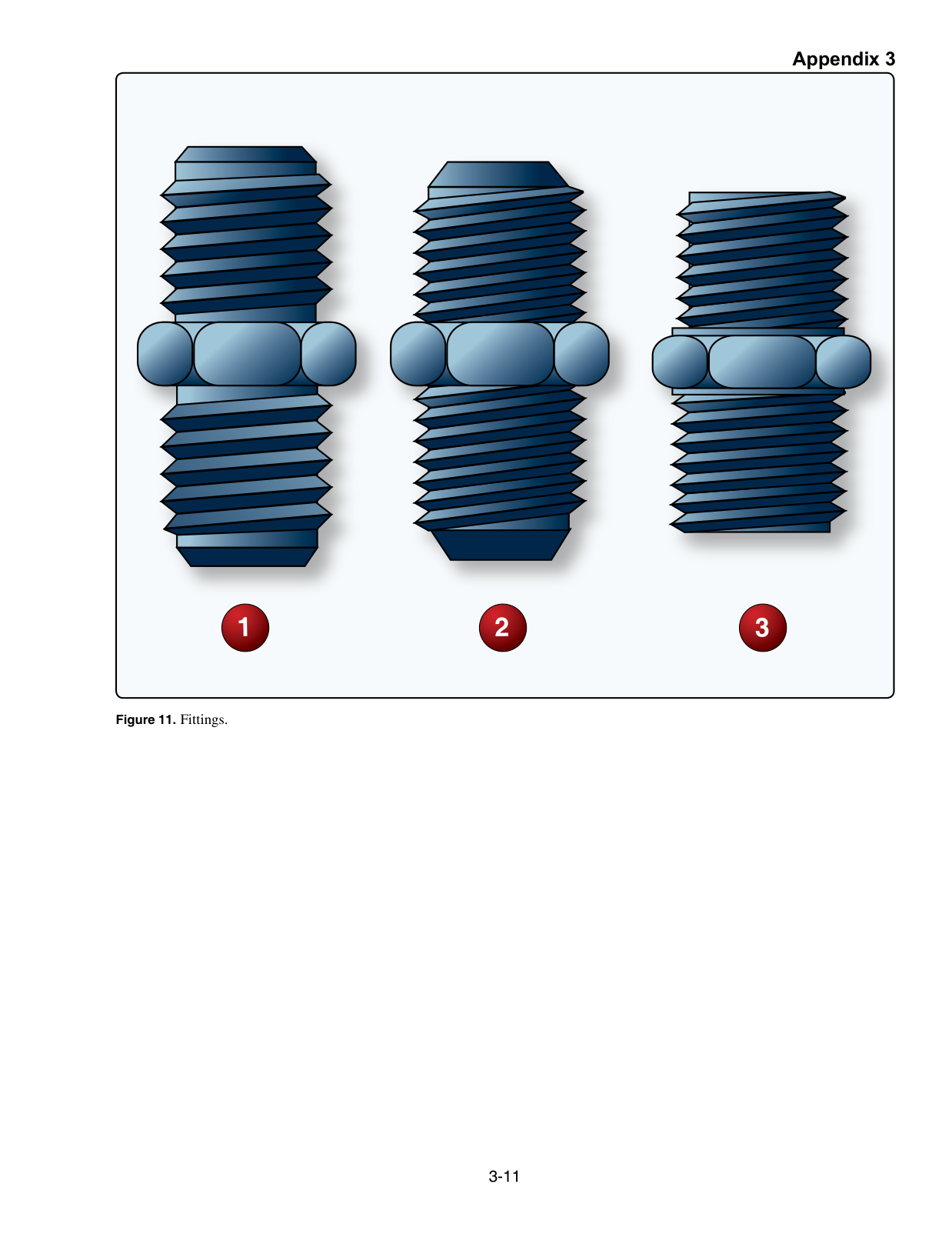
(Refer to FAA-CT-8080-4G, Appendix 3, Figure 11.) An AN flared tube fitting is referred to in which picture?
- 1
- 2 ✓
- 3
Why: Picture 2 shows the AN flared tube fitting - identified by straight (parallel) threads and the smooth 37-degree flare cone on the nose against which the tube's flare seats. FAA-CT-8080-4G Appendix 3, Figure 11.
Which of the following is a recognized special (conditional) inspection?
- A lightning-strike inspection ✓
- A daily preflight walk-around
- A 100-hour inspection
Why: Special (conditional) inspections are triggered by unusual events — hard/overweight landing, severe turbulence/over-G, and lightning strike — each following the manufacturer's specific inspection details. FAA-H-8083-31B ch.2.
A capacitance fuel quantity system has an advantage over a simple float system in that it can do what?
- Measure fuel by mass and average many probes for accuracy despite aircraft attitude changes ✓
- Operate with no electrical power at all
- Indicate fuel quantity without any tank sensors per the applicable maintenance manual per the applicable maintenance manual
Why: Capacitance systems use multiple probes whose readings are summed, so they remain accurate as the aircraft changes attitude, and (with density compensation) can indicate fuel by mass — important for turbine performance. FAA-H-8083-31B ch.14.
When converting/servicing a system for phosphate ester (Skydrol) fluid, which seals must be used?
- Butyl rubber or ethylene-propylene (EPDM) seals — neoprene and Buna-N are not compatible ✓
- Neoprene or Buna-N seals, the same as for petroleum fluid
- Any synthetic rubber seal, since seal material does not matter with Skydrol
Why: Phosphate ester-based fluids are not compatible with neoprene or Buna-N seals; those must be replaced with butyl rubber or ethylene-propylene elastomer seals. FAA-H-8083-31B ch.12.
Which 14 CFR part contains the general operating and flight rules, including the aircraft inspection requirements?
- Part 91 ✓
- Part 43
- Part 21
Why: 14 CFR part 91 (General Operating and Flight Rules) contains the inspection requirements (section 91.409); part 43 covers maintenance methods and records; part 39 covers ADs. 14 CFR 91.409.
Why are heater blankets, inline heaters, and thermostats fitted to potable water and waste lines and drain masts?
- To prevent the water/waste from freezing and bursting or blocking the lines at low temperature ✓
- To warm the water for passenger comfort during cruise according to the manufacturer's service data
- To speed the flow of waste by reducing its viscosity
Why: Heater blankets/boots, inline heaters, and thermostatically controlled drain-mast heaters keep the water supply lines, waste drain lines, and drain masts above freezing so they do not freeze, burst, or block in flight. FAA-H-8083-31B ch.15.
Minimum rivet spacing (center to center in a row) must not be less than what for protruding-head versus flush-head rivets?
- 3.5 diameters for protruding head, 4 diameters for flush head ✓
- 2 diameters for protruding head, 2.5 diameters for flush head
- 5 diameters for protruding head, 6 diameters for flush head
Why: Minimum spacing between protruding-head rivets is 3.5 times the diameter; between flush-head rivets it is 4 times the diameter. FAA-H-8083-31B ch.4.
Composite structures are made of a fiber reinforcement held together by what?
- A matrix of thermosetting or thermoplastic resin ✓
- A core of aluminum honeycomb only
- A bonding layer of pure epoxy primer only
Why: A composite consists of fiber reinforcement embedded in a matrix; the matrix is a resin, either thermosetting or thermoplastic, that binds the fibers and transfers load. FAA-H-8083-31B ch.7.
What is the function of a voltage regulator in a generator/alternator system?
- To maintain a constant system voltage by controlling the field current ✓
- To convert the generator's AC output into DC
- To disconnect the battery when the engine is not running
Why: The voltage regulator automatically maintains a constant system voltage by adjusting the current in the generator/alternator field circuit as load and speed change. FAA-H-8083-31B ch.9.
What is the purpose of a constant speed drive (CSD) in an AC generation system?
- To drive the AC generator at a constant speed so it produces a constant frequency (e.g., 400 Hz) despite engine speed changes ✓
- To rectify the generator's AC output into DC per the applicable maintenance manual according to the manufacturer's service data
- To store energy for engine starting
Why: A constant speed drive (CSD) drives the AC generator at a constant rotational speed regardless of engine speed, so the generator produces a constant-frequency output (typically 400 Hz). An integrated drive generator (IDG) combines the CSD and generator. FAA-H-8083-31B ch.9.
On a semimonocoque fuselage, the skin is reinforced by longitudinal structural members called
- beams and struts.
- longerons and stringers. ✓
- formers and bulkheads.
Why: On a semimonocoque fuselage the skin is reinforced by longitudinal members called longerons and stringers. FAA-H-8083-31B ch.1.
What is the function of the fuel selector valve?
- To select which tank feeds the engine and to shut the fuel off (fuel ON/OFF and tank selection) ✓
- To meter the exact fuel-air ratio delivered to the cylinders per the applicable maintenance manual
- To regulate cabin pressure during climb and descent
Why: The fuel selector valve lets the pilot choose which tank supplies the engine and provides a fuel shutoff (ON/OFF); on twins it may also allow crossfeed between engines. FAA-H-8083-31B ch.14.
How does a fuse differ from a circuit breaker as a circuit protection device?
- A fuse contains a metal element that melts and must be replaced; a circuit breaker can be reset ✓
- A fuse can be reset after it opens; a circuit breaker must be replaced per the applicable maintenance manual
- Both must be replaced after operating and neither can be reset
Why: A fuse has a metal (lead/tin) element that melts when current exceeds its rating, and it must be replaced; a circuit breaker opens on overcurrent but can be reset to restore the circuit. FAA-H-8083-31B ch.9.
Which steel alloy is the common chrome-molybdenum tubing welded in aircraft tubular structures?
- 4130 steel ✓
- 1010 steel
- 7075 aluminum
Why: 4130 (chrome-molybdenum) steel is the common aircraft tubing; it is frequently welded with the TIG (GTAW) process. FAA-H-8083-31B ch.5.
Under certain conditions, type A rivets are not used because of their
- low strength characteristics. ✓
- unique design that causes crazing or cracking.
- tendency toward embrittlement when subjected to vibration.
Why: Type A (1100) rivets are not used on structural joints because of their low strength characteristics. FAA-H-8083-31B ch.4.
Dynamic balancing of a helicopter main rotor corrects what kind of vibration?
- A lateral (spanwise) imbalance vibration, by adding/removing weight at the hub or blade ✓
- A high-frequency tail-rotor drive vibration per the applicable maintenance manual
- An electrical noise in the avionics
Why: Dynamic (spanwise) balancing corrects a lateral once-per-rev vibration caused by a blade or hub imbalance, by adding or moving small weights; tracking corrects vertical (out-of-plane) vibration. FAA-H-8083-31B ch.2.
A gaseous oxygen system is leak-tested using what?
- A leak-detection solution (or soap) applied to fittings, watching for bubbles, on the pressurized system ✓
- An open flame passed slowly along each fitting
- A vacuum pump that evacuates the system overnight per the applicable maintenance manual according to the manufacturer's service data
Why: Gaseous oxygen systems are leak-checked by applying an approved oxygen-compatible leak-detection solution to the high-pressure fittings and watching for bubbles; never use oil-based products. FAA-H-8083-31B ch.16.
On a low-wing single-engine airplane, why is a fuel pump required (rather than gravity feed)?
- The tanks are below the engine, so a pump is needed to lift fuel up to the engine ✓
- Low-wing tanks hold too much fuel for gravity to move per the applicable maintenance manual
- Gravity feed is prohibited on all certified aircraft
Why: On a low-wing airplane the fuel tanks are below the engine, so fuel cannot flow by gravity; an engine-driven pump (with an electric boost pump) is required to deliver fuel up to the engine. FAA-H-8083-31B ch.14.
Which 14 CFR part governs the identification and registration marking of aircraft?
- Part 45 ✓
- Part 47
- Part 39
Why: 14 CFR part 45 governs identification and registration marking (nationality and registration marks); part 47 covers aircraft registration itself. FAA-H-8083-31B ch.2.
Why is a visual inspection of hydraulic fluid alone insufficient to judge contamination?
- Fluid that looks clean to the naked eye can still be contaminated to the point of being unfit for use ✓
- Hydraulic fluid is opaque and cannot be seen through at all
- The color of the fluid always changes before any contamination occurs per the applicable maintenance manual
Why: Filters remove particles visible to the eye, so fluid that appears clean may still be contaminated beyond usable limits; laboratory sampling is required to determine actual contamination. FAA-H-8083-31B ch.12.
Built-in test equipment (BITE) in modern avionics does what?
- Performs automatic self-tests and reports faults, aiding troubleshooting without external test gear ✓
- Replaces the need for any scheduled inspection of the avionics per the applicable maintenance manual
- Physically swaps failed circuit cards automatically in flight
Why: Built-in test equipment (BITE) lets a unit run automatic self-tests and store/report fault codes, which speeds troubleshooting and often isolates a failure to a line-replaceable unit without external test equipment. FAA-H-8083-31B ch.10.
A dangerous overheating condition in a nickel-cadmium (NiCd) battery, in which temperature and charging current increase uncontrollably, is called what?
- Thermal runaway ✓
- Sulfation
- Memory effect per the applicable maintenance manual
Why: Thermal runaway is a self-reinforcing overheating of a NiCd battery: heat lowers cell resistance, which raises charging current, which raises temperature further, potentially destroying the battery. FAA-H-8083-31B ch.9.
'Translating tendency' (drift) in a hovering helicopter is caused by what?
- The sideward thrust of the tail rotor, which tends to drift the whole helicopter sideways ✓
- The main rotor blades coning upward under load per the applicable maintenance manual per the applicable maintenance manual
- Gyroscopic precession of the tail rotor
Why: Translating tendency (drift) is the tendency of the whole helicopter to move sideways in a hover due to the tail rotor's sideward thrust; it is compensated by rigging, cyclic bias, or offsetting the rotor mast. FAA-H-8083-31B ch.2.
Wood is described as hygroscopic, which means it does what?
- Absorbs and releases moisture with changes in humidity, causing swelling or shrinking ✓
- Completely repels water and never changes its dimensions regardless of the surrounding humidity level
- Begins to conduct electricity as soon as its internal moisture content rises above the normal level
Why: Wood is hygroscopic — it absorbs and gives off moisture as humidity changes, which causes it to swell or shrink; moisture control is essential to prevent decay. FAA-H-8083-31B ch.6.
Propeller ice protection is most commonly provided by what?
- Electrically heated boots on the blade shanks, or a chemical (glycol) fluid slung out by a slinger ring ✓
- Pneumatic boots that inflate on each blade
- Bleed air ducted through the hollow propeller blades per the applicable maintenance manual
Why: Propellers are typically deiced by electrothermal (electrically heated) boots on the blade shanks, or by a chemical anti-ice fluid delivered to a slinger ring on the hub that flings the fluid onto the blades. FAA-H-8083-31B ch.15.
Which cable diameters are made in the 7x19 (very flexible) construction?
- 1/8 inch through 3/8 inch ✓
- 1/16 inch through 3/32 inch
- 3/8 inch through 1/2 inch
Why: The very flexible 7x19 cable is made in diameters from 1/8 inch to 3/8 inch; the medium-flexibility 7x7 cable is made from 1/16 to 3/32 inch. FAA-H-8083-31B ch.2.
A ground proximity warning system (GPWS) alerts the crew to what?
- A dangerous closure with terrain or the ground, prompting a 'pull up' warning ✓
- Traffic conflicts with other aircraft at the same altitude per the applicable maintenance manual
- A loss of cabin pressurization
Why: A GPWS (or enhanced EGPWS) monitors the aircraft's height and closure rate with terrain and warns the crew of an impending collision with the ground (e.g., an aural 'terrain, pull up'). FAA-H-8083-31B ch.11.
Gyroscopic precession affects a rotor such that a control force applied at one point takes effect where?
- Approximately 90 degrees later in the direction of rotation ✓
- At the exact point where the force is applied
- 180 degrees opposite the point of application
Why: Because the spinning rotor acts like a gyroscope, a force applied to change the disk takes effect approximately 90 degrees later in the direction of rotation (gyroscopic precession); rotor controls are rigged to account for this. FAA-H-8083-31B ch.2.
Which part of 2017-T36 aluminum alloy indicates the temper designation?
- T36. ✓
- 2
- 17
Why: In 2017-T36, 'T36' is the temper designation. Materials/hardware.
Why must bleed air used for cabin heating be temperature-controlled before entering the cabin?
- Compressor bleed air is extremely hot and must be cooled/mixed to a safe, comfortable temperature ✓
- Bleed air is too cold and must always be heated further before use per the applicable maintenance manual
- Bleed air carries refrigerant that must be removed first
Why: Engine compressor bleed air is extremely hot; it must be cooled (via heat exchangers and mixing with cooler air) and temperature-regulated before it is delivered to the cabin. FAA-H-8083-31B ch.16.
Gray water (waste water) tanks collect what?
- The used wash water draining from the galley and lavatory sinks ✓
- The potable drinking water before it reaches the faucets per the applicable maintenance manual
- The hydraulic fluid returning from the actuators
Why: Waste (gray) water tanks collect the used wash water that drains from the galley and lavatory sinks; toilet waste goes to the separate waste (black water) tank. FAA-H-8083-31B ch.16.
Which document records a major repair or major alteration and must be filed with the FAA?
- FAA Form 337 ✓
- FAA Form 8130-3
- FAA Form 8050-1
Why: A major repair or major alteration is recorded on FAA Form 337; a copy goes to the FAA (Aircraft Registration Branch) and one is retained with the aircraft records. 14 CFR part 43 (App B).
Which instrument measures control cable tension, and how accurate is it when properly maintained?
- A tensiometer, which is about 98 percent accurate when properly maintained ✓
- A turnbuckle gauge, which is about 75 percent accurate when properly maintained
- A dial torque wrench, which is about 90 percent accurate when properly maintained
Why: A tensiometer measures cable tension using anvils and a riser/plunger; when properly maintained it is about 98 percent accurate. FAA-H-8083-31B ch.2.
Boron fiber is particularly useful for what repair, because its thermal expansion is close to that of the parent metal?
- Reinforcing/repairing cracked aluminum aircraft skins ✓
- Covering fabric-skinned wooden wings
- Insulating electrical bays from lightning
Why: Boron fiber is used to repair cracked aluminum skins because its thermal expansion is close to aluminum and it poses no galvanic corrosion risk; it is stiff, expensive, and mainly military. FAA-H-8083-31B ch.7.
'Clad' (Alclad) aluminum sheet consists of what for corrosion protection?
- A thin coating of pure aluminum bonded over the higher-strength alloy core ✓
- A layer of zinc chromate primer baked onto the alloy surface
- An anodized oxide film grown electrolytically on both surfaces
Why: Clad (Alclad) aluminum has a thin coating of corrosion-resistant pure aluminum rolled onto the surface of the stronger alloy core; corrosion pits in the cladding are a defect to watch for. FAA-H-8083-31B ch.4.
How is the charge of a stored fire extinguisher bottle commonly verified during maintenance?
- By weighing the bottle and/or checking its pressure gauge against the specification ✓
- By discharging it into the atmosphere and observing the spray per the applicable maintenance manual
- By measuring the electrical resistance of the agent
Why: A fire bottle's charge is verified by weighing it (comparing to the specified full weight) and/or reading its pressure gauge, corrected for temperature; a bottle below limits is recharged or replaced. FAA-H-8083-31B ch.17.
After a lightning strike, the special inspection focuses on what?
- Burn/exit points, bonding straps, static wicks, and structure/composite for damage ✓
- Only repainting the burned surface area over with an electrically conductive primer coating
- Only replacing the navigation and anti-collision lights that were affected by the strike
Why: A lightning-strike special inspection checks entry/exit burn points, bonding jumpers, static wicks, and structure (including composites and their lightning-protection mesh) for damage, per the manufacturer's instructions. FAA-H-8083-30B ch.10.
A common way to measure high engine temperatures such as exhaust gas temperature is with what?
- A thermocouple, which generates a voltage proportional to the temperature difference at its junction ✓
- A bimetallic strip read directly on the flight deck gauge per the applicable maintenance manual per the applicable maintenance manual
- A capacitance probe immersed in the exhaust stream
Why: High temperatures (EGT, CHT on some engines) are measured with thermocouples, which produce a small voltage proportional to the temperature difference between the measuring and reference junctions. FAA-H-8083-31B ch.10.
Aramid (Kevlar) fiber is prized for impact resistance but has which disadvantage?
- It is weak in compression and hygroscopic, absorbing up to 8 percent of its weight in water ✓
- It readily conducts electricity and therefore must be carefully isolated from all avionics wiring
- It is extremely brittle and tends to shatter on even a very minor impact against the surface
Why: Aramid (Kevlar) is light, tough, and impact-resistant, but is weak in compression and hygroscopic (absorbing up to 8 percent of its weight in water), so it must be protected from moisture. FAA-H-8083-31B ch.7.
Which of the following is one advantage of Hi-Lok fasteners?
- Shorter transition area between the shank and thread.
- External counterbore at the base to accomodate material thickness.
- Inability to be over-torqued. ✓
Why: A Hi-Lok fastener's collar shears off at the correct torque, so it cannot be over-torqued. FAA-H-8083-31B ch.4.
When installing an instrument in an aircraft, who is responsible for making sure it is properly marked?
- The aircraft owner or pilot.
- The mechanic installing the instrument. ✓
- The manufacturer of the instrument.
Why: The mechanic installing the instrument is responsible for ensuring it is properly marked for that installation. FAA-H-8083-31B ch.10.
Which statement correctly compares gravity-feed and pump-feed fuel systems?
- Gravity feed is simpler with no pump (high-wing); pump feed uses boost and engine-driven pumps (low-wing) ✓
- Gravity feed uses two pumps; pump feed uses none
- Both systems require the pilot to hand-pump fuel continuously per the applicable maintenance manual
Why: Gravity-feed systems are the simplest (no pump, high-wing, fuel above the engine); pump-feed systems (low-wing) use an electric boost pump plus an engine-driven pump because the fuel is below the engine. FAA-H-8083-31B ch.14.
Modern multiengine aircraft protect their potential fire zones with what?
- A fixed fire protection (detection and extinguishing) system ✓
- Only portable hand extinguishers stowed in the cabin
- No system, relying on the crew to spot flames visually per the applicable maintenance manual
Why: The potential fire zones of modern multiengine aircraft (such as engine nacelles) are protected by fixed fire protection systems that both detect and extinguish fires. FAA-H-8083-31B ch.17.
Why is the use of Halon extinguishing agents being restricted and replaced?
- Halon is an ozone-depleting substance, so its production has been restricted ✓
- Halon is too corrosive to aluminum aircraft structure per the applicable maintenance manual
- Halon leaves a heavy residue that damages electronics
Why: Halon agents are effective but are ozone-depleting; their production has been restricted under environmental agreements, driving development of replacement (halon-alternative) agents. FAA-H-8083-31B ch.17.
What is the appropriate method for installing pre-insulated terminal lugs and splices to electric wires?
- Using a crimping tool to secure the terminal lug. ✓
- Soldering the terminal lug to the end of the wire.
- Soldering the exposed wire prior to crimping on the terminal lug.
Why: Pre-insulated terminal lugs and splices are installed with a crimping tool (not soldered). FAA-H-8083-31B ch.9.