FAA Inspection Authorization (IAR) Knowledge Test, Practice Exams
Revision Mode
Revise with instant feedback: the moment you pick an answer you see whether it was right, with the handbook-cited explanation. Untimed — ideal before you sit a mock test. Questions you miss keep coming back until you know them.
Exam Mode
Test-day conditions: no feedback until you submit, each knowledge area scored separately, with a full question-by-question review at the end.
The real test requires 70% to pass. Each knowledge area is scored separately here so you know exactly where you stand.
Knowledge areas & your progress
Unlock the full question bank
The free sample gives you about two exams' worth of questions per knowledge area. The full bank covers every knowledge area in depth, with source-cited explanations. $49, one time, lifetime access on up to 3 devices — all five tests (Mechanic General, Airframe, Powerplant, Part 107 Remote Pilot, and Inspection Authorization) included.
✓ One purchase, every written test · up to 3 devices · no subscription · no account needed
Score history
Reviews
Review
Frequently asked questions
How is the FAA Inspection Authorization (IAR) Knowledge Test structured?
The real Inspection Authorization written test has 50 multiple-choice questions (3 options each), a 3-hour time limit, and requires 70% to pass. Questions are drawn across 11 knowledge areas. The FAA publishes no ACS and no percentage weighting for this test, so these were derived by classifying its own 50 published sample questions, and this bank mirrors them.
What score do I need to pass?
70 percent. Revise each knowledge area to that level in Revision Mode, then run the full exam simulation in Exam Mode before your test date.
Are these real FAA exam questions?
The live test bank is not published. Our questions include the FAA's own published sample questions plus original questions written to knowledge areas derived from the FAA's own published sample questions and grounded in 14 CFR parts 1, 21, 23, 39, 43, 65 and 91, AC 43.13-1B, AC 120-77 and the FAA Aviation Maintenance Technician Handbooks, with the source cited in each explanation.
How many practice questions are included?
The full Inspection Authorization bank contains 250 questions with explanations. The free sample gives you roughly two exams' worth per knowledge area.
Who is eligible to sit the IA knowledge test?
14 CFR 65.91 sets the bar before the test: a currently effective mechanic certificate with both airframe and powerplant ratings, each held for at least 3 years; at least 2 years actively maintaining certificated aircraft immediately beforehand; a fixed base of operations; and the equipment, facilities and inspection data to do the inspecting. Fail the written and you may not apply to retest for 90 days.
What does access cost?
$49, one time, for lifetime access to every test on the site and everything we add later. No subscription.
Can I use it on more than one device?
Yes. One purchase works on up to 3 of your devices. Your progress is saved on each device.
Do I need to create an account?
No. The practice tests run in your browser with no signup. Your score history is saved on your own device.
What topics does the FAA Inspection Authorization (IAR) Knowledge Test question bank cover?
It is organised into 11 modules that follow the exam's own content areas: Major repairs and major alterations, Inspection programmes: annual, progressive and 100-hour, Return to service and IA privileges, Maintenance records and FAA Form 337, Approved data, STCs and Type Certificate Data Sheets, Airworthiness Directives and service information, Instructions for Continued Airworthiness, Weight and balance after repair or alteration, Sheet metal and structural repairs, Aircraft systems: hydraulic, electrical and instrument and Engines and propellers. Each module is drilled and scored separately, so you can see exactly which areas are exam-ready and which still need work.
When was this question bank last updated?
Last updated 16 September 2026. The bank is revised whenever the source material it cites changes, and every question carries the source its explanation is drawn from.
Sample FAA Inspection Authorization (IAR) Knowledge Test practice questions
A selection of free questions with answers and explanations. Use the interactive modules above for timed, scored drills.
An applicant applies to change a type certificate. Which regulations must the change comply with, under 21.101(a)?
- The regulations that were incorporated by reference in the original type certificate for the product, together with any regulation the FAA finds to be directly related to the change proposed
- The airworthiness requirements in effect on the date on which the change is approved, together with any special conditions and amendments to them prescribed under 21.16
- The airworthiness requirements applicable to the category of product in effect on the date of the application for the change, and parts 34, 36 and 38 ✓
Why: 21.101(a) fixes the baseline at the date of APPLICATION for the change, not the date of approval, and adds the fuel venting and exhaust emissions, noise and fuel efficiency parts. 21.101(b) then allows an earlier amendment to be used in three situations - a change the FAA finds not significant, an area not affected by the change, and an area where compliance would not contribute materially to safety or would be impractical - subject to a floor at the regulations incorporated in the type certificate.
Fabric covering on a wing is repaired. Appendix A makes the repair major once the area involved is greater than
- the area required to repair two adjacent ribs ✓
- six inches in any direction
- half of one wing panel
Why: Appendix A(b)(1)(xxvi) states the fabric threshold as an area greater than that required to repair two adjacent ribs. The six inch figure belongs to a different sub-paragraph, (xxii), which is about metal or plywood stressed covering - carrying it across to fabric is the common mistake. Replacing the fabric on a fabric-covered part outright is separately a major repair under sub-paragraph (xxvii), whatever the area.
What standard does 43.13(b) set for the condition of an aircraft after maintenance or alteration?
- Equal to the condition described in the type certificate data sheet for the make, model and serial number of the aircraft concerned
- At least equal to its original or properly altered condition, in aerodynamic function, structural strength, resistance to vibration and deterioration, and other qualities affecting airworthiness ✓
- Sufficient for safe operation, as determined by the person approving the aircraft or component for return to service after the work
Why: 43.13(b) requires the manner of working and the quality of the materials to leave the item at least equal to its original or properly altered condition, and it spells out the qualities that have to be preserved. 'Properly altered' matters: the benchmark for an aircraft that has been legitimately modified is the modified configuration, not the one that left the factory. AC 120-77 paragraph 5r relies on the same section when it describes substantiating data as data showing that an article complies with the applicable airworthiness standards.
Show more sample questions with answers & explanations
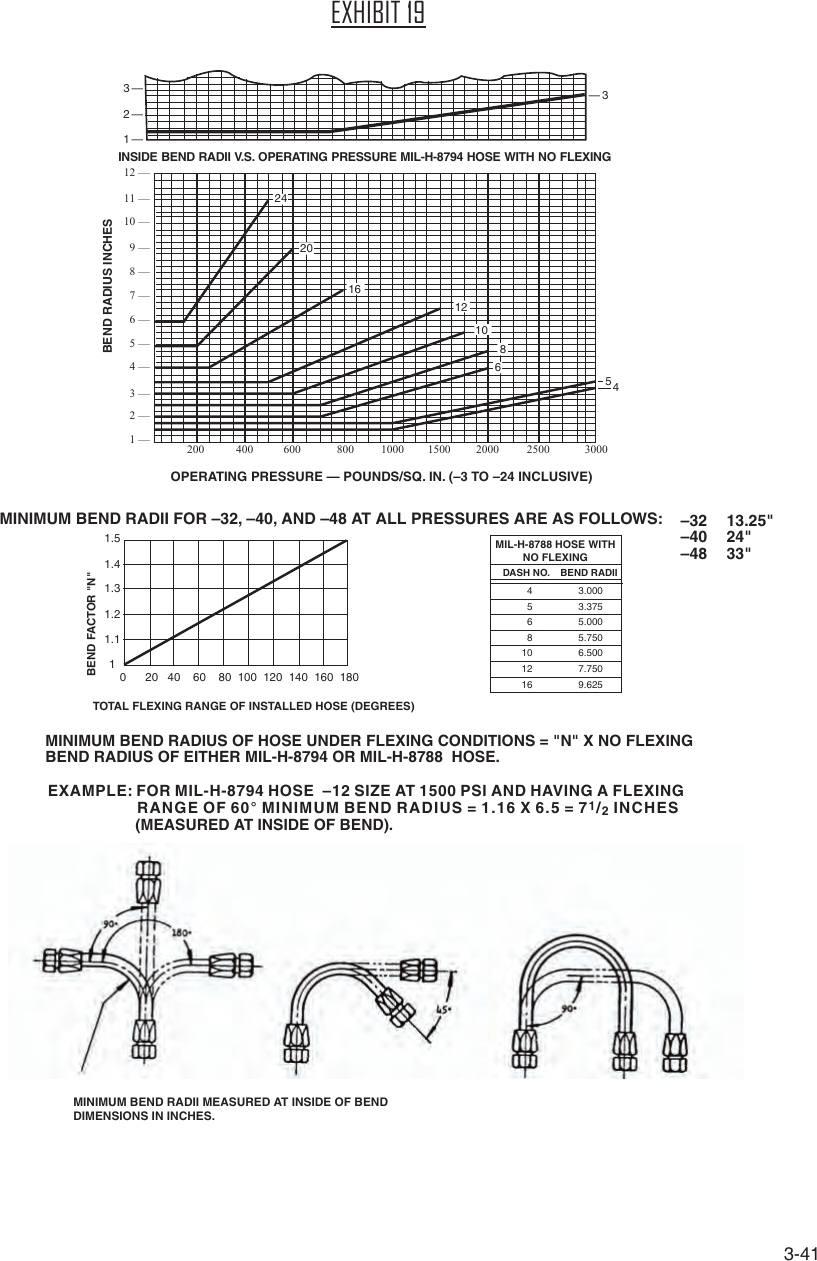
(Refer to the minimum bend radii exhibit.) How is the minimum allowable bend radius affected by the installation angle of a hydraulic hose in a non-flexing, constant pressure system? As the angle increases, the minimum bend radius
- increases.
- decreases.
- remains constant. ✓
Why: Look at what each half of the exhibit is plotted against. The no-flexing chart gives inside bend radii against operating pressure alone, so for a fixed pressure it returns one radius. The bend factor N, which multiplies that radius, is plotted against the total flexing range of the installed hose in degrees - it only applies where the hose flexes. In a non-flexing installation at constant pressure the angle is simply not an input, so the minimum bend radius does not change.
During an annual you find that a mechanic repaired four adjacent wing ribs and the leading edge between them. Under appendix A that work was
- a minor repair, because ribs are not primary structure
- an airframe major repair ✓
- preventive maintenance, because no seams were added to the skin
Why: Appendix A(b)(1)(xxv) makes the repair of three or more adjacent wing or control surface ribs, or of the leading edge between such adjacent ribs, an airframe major repair. Four ribs is over the threshold. The other options misdescribe the rule: wing main ribs and compression members are named as primary structure at sub-paragraph (x), and the preventive maintenance list in appendix A(c) contains no rib repair of any size.
What does a structural repair manual provide, and what is its status as data?
- Approved data in every case, because an SRM is issued only under the authority of a type certificate holder
- Allowable damage limits only, repair instructions being confined to the maintenance manual and component maintenance manuals
- Repair instructions, material substitutions and allowable damage limits, which are acceptable methods in the same way as other service documents unless the FAA has approved the SRM ✓
Why: AC 120-77 paragraph 8b describes the content and then puts the SRM in the same category as the maintenance, component and overhaul manuals - acceptable methods, techniques and practices under 43.13(a). Manufacturers typically REQUEST FAA approval of the SRM so that operators and repair stations have ready access to approved data for major repairs, which is exactly what that request would be unnecessary for if an SRM were approved data by its nature.
An aircraft has been modified in the very area that an airworthiness directive addresses. Does the AD still apply?
- No, because the modification supersedes the configuration the AD was written against, provided it was approved data
- Yes, 39.15 applies an AD to each product identified in it even where that individual product has been modified, altered or repaired in the area addressed ✓
- Only if the modification was carried out after the effective date of the airworthiness directive concerned
Why: 39.15 closes the obvious escape route: the AD applies to each product it identifies even where the individual product has been changed in the area the AD addresses. What a modification can do is make the required actions impossible or meaningless, and 39.17 deals with that separately - it requires a request for FAA approval of an alternative method of compliance, and unless the change can be shown to have eliminated the unsafe condition, the request must propose specific actions.
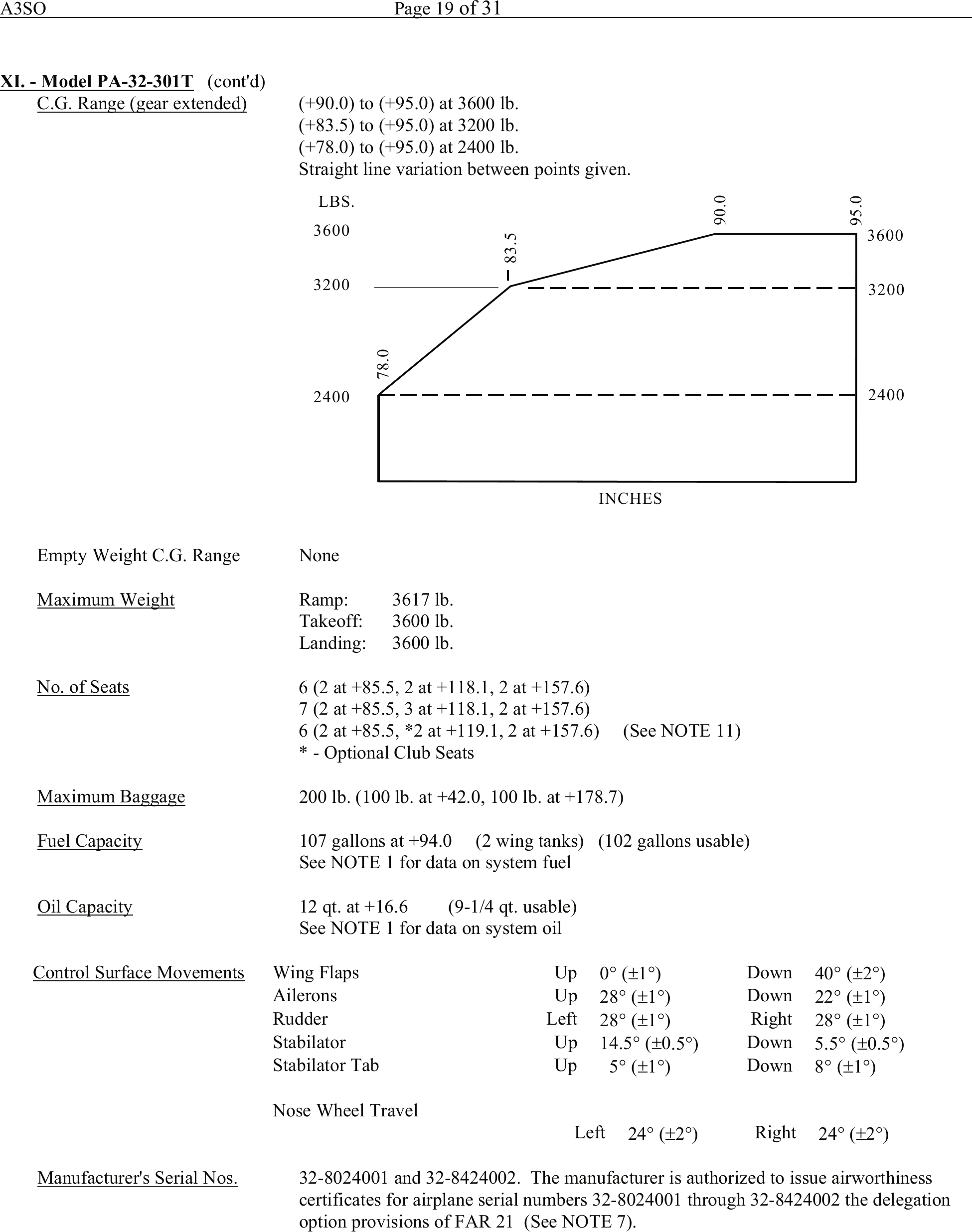
(Refer to the Type Certificate Data Sheet excerpt.) How many club seats may be installed in Piper PA32-301T, serial number 8221552?
- 1
- 2 ✓
- 4
Why: Serial 32-8221552 falls inside the range the data sheet gives for the PA-32-301T, 32-8024001 through 32-8424002. The seating entry for that model offers three arrangements, and the one marked with an asterisk reads 6 (2 at +85.5, *2 at +119.1, 2 at +157.6), with the footnote '* - Optional Club Seats'. Two seats carry the asterisk, so two club seats may be installed.
For which of the following may a special flight permit be issued under 21.197(a)?
- Flying an aircraft to a base where repairs, alterations or maintenance are to be performed, or to a point of storage ✓
- Carrying passengers on a revenue flight where an inoperative item is permitted by the minimum equipment list for the aircraft type
- Operating an aircraft whose annual inspection has lapsed, for the purpose of maintaining pilot currency until the inspection is carried out
Why: 21.197(a) lists five purposes: flying to a base for repairs, alterations or maintenance or to a point of storage; delivering or exporting the aircraft; production flight testing new production aircraft; evacuating aircraft from areas of impending danger; and customer demonstration flights in new production aircraft that have passed their production flight tests. 21.197(b) adds a separate case, operation above maximum certificated takeoff weight for flight beyond the normal range, with the excess limited to fuel, fuel-carrying facilities and navigation equipment.
Why must all openings in a hydraulic system be capped or plugged when a unit or a line is removed?
- To stop the residual pressure in the accumulator discharging through the open line and injuring personnel working nearby
- To keep the system fluid from absorbing atmospheric moisture, which lowers its flash point and promotes internal corrosion
- To prevent contamination of the system ✓
Why: Contamination is the reason the circular gives, and it is the same concern that runs through the whole of the maintenance paragraph - care to prevent system contamination, damage to seals and packings, and incorrect torque at the fittings. Used fluid raises a separate question the circular also answers: in the absence of organisational guidelines, follow local, state and federal regulations, and the most universally accepted disposal method for phosphate ester based fluid is incineration.
How are the arms of the weighing points found when they are not already known?
- By taking them from the type certificate data sheet for the aircraft, which gives the arm of each landing gear station
- By measuring from the centre of each weighing point to the nose of the aircraft and applying the datum offset given by the manufacturer
- By dropping a plumb bob from the centre of each weighing point and from the datum, marking the floor, and measuring the perpendicular distances ✓
Why: The arm for a weighing point is the distance from the centre of the weight transfer point to the datum, and where previous weighings or other data do not give it, it is measured on the day. Plumb bobs and chalk marks on the hangar floor turn a three-dimensional problem into a measurement along the floor. Where a skid rests on a scale a length of pipe is used between the skid and the scale so that the point of weight transfer is known.
Airworthiness Directives (AD's) may be issued to aircraft for which of the following categories?
- Primary, Standard, Ultralight, and Rotorcraft.
- Experimental, Restricted, Powered Lift, and Rotorcraft.
- Experimental, Standard, Primary and Restricted. ✓
Why: 39.3 makes ADs apply to products without carving out any airworthiness certificate category, so the correct option is the one naming four genuine certificate categories. Ultralights are not certificated aircraft at all - they operate under Part 103 - and powered-lift and rotorcraft are aircraft categories rather than classes of airworthiness certificate.
When does an inspection authorization expire?
- Two years after the date of issue, whatever date that falls on in the calendar
- On 31 December of the second calendar year after the year in which it was issued
- On 31 March of each odd-numbered year ✓
Why: 65.92(a) fixes a common expiry date rather than a rolling anniversary: every inspection authorization expires on 31 March of each odd-numbered year. The same paragraph then adds a continuing condition - the privileges may only be exercised while the holder has a currently effective mechanic certificate with both an airframe and a powerplant rating currently effective.
A 100-hour inspection has been completed and properly recorded. When may it count as the annual inspection required by 91.409(a)?
- When it was performed by a person authorised to perform annual inspections and entered as an 'annual' in the required maintenance records ✓
- Never - the annual and the 100-hour are separate requirements and neither can stand in for the other, whatever the qualifications of the person who signs the record
- Whenever the scope and detail of part 43 appendix D have been covered, because the annual and the 100-hour inspection have exactly the same scope and detail
Why: The closing sentence of 91.409(a) says no inspection performed under paragraph (b) may be substituted for the annual unless it is done by someone authorised to perform annual inspections and is entered as an 'annual' in the records. Both halves matter. Covering appendix D is not enough by itself, because the scope of the two inspections is identical anyway - what differs is who may sign and what the entry says.
A single-lap splice is being designed in 0.040 inch clad 2024 sheet. What rivet diameter does AC 43.13-1B suggest as a starting point?
- About 0.020 inch, or half the sheet thickness, so that the hole does not weaken the sheet
- About 0.120 inch, or three times the sheet thickness, so a 1/8 inch rivet is chosen ✓
- About 0.080 inch, or twice the sheet thickness, so a 5/64 inch rivet is chosen
Why: The rule of thumb in the worked splice example is a rivet diameter of approximately three times the sheet thickness, and the nearest standard size is then taken. The Airframe handbook states the same relationship when it says the diameter of the rivet is found by multiplying the thickness of the skin material by three. A rivet much smaller than that shears before the sheet does, which defeats the purpose of the joint.
An owner asks you to carry out an alteration using an STC held by a company that has since been taken over. What must be in hand before the work starts?
- Written permission from the current holder of the STC, acceptable to the FAA, which 21.120 requires that holder to provide ✓
- A copy of the STC and the associated installation instructions, which is all that 21.119 requires the holder to release
- Confirmation from the responsible Flight Standards office that the STC is still effective following the change of ownership
Why: 21.120 places the duty on the STC holder to provide written permission acceptable to the FAA to anyone it allows to use the STC to alter an aircraft, engine or propeller, and 91.403(d) places the matching prohibition on the other side - an aircraft must not be altered on the basis of an STC unless the owner or operator holds it or has that written permission. Having the data is not the same as having the right to use it, which is why possession of the installation instructions settles nothing.
What happens to the thickness of the metal in the bend area when a sheet is formed, and what is assumed about the neutral axis?
- The bend area thickens by 10 to 15 percent and the neutral axis moves outward, away from the radius centre
- The thickness is unchanged, because the material on the outside of the bend stretches by exactly as much as the material on the inside of it compresses, leaving the neutral axis at the centre
- The bend area is 10 to 15 percent thinner and the neutral axis moves in towards the radius centre, though it is assumed to lie at the centre of the material ✓
Why: The neutral axis is the imaginary line that is the same length after bending as before it. Thinning in the bend area moves it towards the inside of the bend, but the handbook says the error in assuming it lies at the centre of the material is so slight that for most work the assumption is satisfactory - which is what allows the R plus half T in the bend allowance formula.
A de-icing system is being redesigned on a light twin, changing the basic design of the system. How does appendix A classify that work?
- An airframe major alteration ✓
- A minor alteration unless the aircraft's weight changes
- An appliance major repair
Why: Appendix A(a)(1)(xii) names changes to the basic design of the fuel, oil, cooling, heating, cabin pressurisation, electrical, hydraulic, de-icing or exhaust systems as airframe major alterations. Weight is a separate trigger under sub-paragraph (xi), not a condition on this one, so an unchanged weight does not demote the work. An appliance major repair is a different list entirely, at appendix A(b)(4).
During an annual inspection you find an inoperative instrument that 91.213(d)(2) permits to be inoperative. What does 43.11(b) require?
- A placard reading 'Inoperative' on the instrument and on the cockpit control of each inoperative item, and the item added to the signed dated list of discrepancies given to the owner or lessee ✓
- The instrument must be removed or deactivated and the instrument panel opening covered, and the maintenance record must show the removal, before the aircraft is approved for return to service, and no placard is then required
- An entry in the aircraft records is sufficient, since the item is permitted to be inoperative
Why: 43.11(b) requires the placard - which must itself meet the aircraft's airworthiness certification regulations - on each inoperative instrument and on the cockpit control of each item of inoperative equipment, and then requires those items to be added to the signed and dated discrepancy list given to the owner or lessee. Removal and capping is one of the options 91.213(d) allows for dealing with the equipment, but it is not what 43.11(b) demands of the inspector.
What is the setback for a straight bend in 2024-T4 sheet metal of 0.032 inch thickness formed to a bend angle of 30°, with a bend radius of 3/32 inch?
- 0.0337. ✓
- 0.2679.
- 0.1257.
Why: Setback is K times the sum of the bend radius and the metal thickness, where K is the tangent of half the bend angle. Here K is tan 15°, which is 0.26795, and the radius plus thickness is 0.09375 plus 0.032, or 0.12575. Multiplying gives 0.03369, so 0.0337. Notice that the other two options are the two intermediate values - 0.2679 is K on its own and 0.1257 is the radius plus thickness - so stopping one step early produces a wrong answer that looks plausible.
Which Form 337 copies does 91.417(a)(2) require the owner to keep in the permanent record set?
- Copies for each major alteration to the airframe and to the currently installed engines, rotors, propellers and appliances ✓
- Copies for every major repair and every major alteration carried out on the aircraft since it was first certificated
- Copies for each major alteration carried out within the preceding 12 calendar months, the older forms being held by Oklahoma City
Why: 91.417(a)(2)(vi) asks for the forms prescribed by 43.9(d) for each major ALTERATION to the airframe and to the engines, rotors, propellers and appliances CURRENTLY INSTALLED. Two limits are built into that: major repairs are not in this sub-paragraph, and a form for an engine that has since been removed travels with the engine rather than staying with the aircraft. There is no 12-month cut-off.
An amateur-built aircraft with an experimental airworthiness certificate requires what type of inspection?
- Annual inspection.
- Condition inspection. ✓
- Approved aircraft inspection program.
Why: 91.409(c)(1) takes aircraft holding a current experimental airworthiness certificate outside the annual and 100-hour requirements. In their place the operating limitations issued with the certificate call for a condition inspection, which Part 91 describes as equivalent in scope and detail to Appendix D of Part 43.
What does AC 43.13-1B say about leakage from a stationary connection in a hydraulic system?
- It is acceptable up to a slow drip, which is the standard the circular applies to any connection carrying phosphate ester fluid
- It is not permitted, and if found it should be repaired ✓
- It is acceptable provided the system fluid level does not fall measurably between scheduled inspections
Why: No leakage at all from a stationary connection. The judgement calls in the circular are about SEALS rather than connections, and they are framed as four questions: how much fluid is allowed to seep past, what effect the leak has on system operation, whether it creates a hazard or affects surrounding installations, and whether the system will function safely without depleting the reservoirs before the next inspection.
What is tare weight, and what must be done about it?
- The weight of any equipment used to support or level the aircraft that rests on the scales, which must be subtracted from the scale readings ✓
- The weight of the residual fuel and oil in the aircraft, which must be added to the scale readings to give empty weight
- The difference between the scale reading and the last recorded empty weight, which must be investigated before the weighing is accepted
Why: Chocks left on a scale, ground locks on retractable gear, and a jack used to raise a tailwheel aircraft to the level attitude are the handbook's own examples, and all of them are being weighed along with the aircraft. Tare is subtracted from the scale reading. Residual fuel and oil go the other way - they are part of empty weight and belong in the figure, not out of it.
How does 21.93(a) distinguish a minor change in type design from a major change?
- A minor change is one that the FAA has agreed in advance may be approved by a method acceptable to it without any substantiating or descriptive data being submitted to it first, and all other changes are major changes
- A minor change is one that does not require an application for a supplemental type certificate, or an application to amend the original type certificate for the product concerned under the procedures of part 21 subpart D
- A minor change is one that has no appreciable effect on weight, balance, structural strength, reliability, operational characteristics or other characteristics affecting airworthiness; all other changes are major ✓
Why: 21.93(a) defines the minor change by its effect and then makes 'major' the residual - all other changes are major changes. The list is close to part 1's test for a major alteration but not identical: 21.93 adds reliability and operational characteristics, which part 1 does not name. The other two options put the consequences first: 21.95 allows minor changes to be approved by a method acceptable to the FAA, and 21.113 is where the STC or amendment requirement comes from, but both follow the classification rather than making it.
What maintenance does AC 43.13-1B recommend for circuit breakers?
- Measuring the resistance across each breaker with an ohmmeter at every annual inspection and replacing any that read above the manufacturer's limit
- Loading each breaker to its rated current and confirming that it holds for at least one minute before tripping
- Cycling them periodically with no load, to clean contaminants from the contact surfaces ✓
Why: Cycling with no load is the whole of the recommendation, and the mechanism given is that operating the contacts cleans contaminants off them. The two alternatives here are the kind of testing that would take the aircraft's protection out of service to prove it works, which is not what the circular asks for.
An item weighing 5 lb is installed at an arm of -28 inches. What is its moment, and which way does it tend to rotate the aircraft?
- -140 in-lb, tending to rotate the aircraft nose down
- +140 in-lb, tending to rotate the aircraft nose up
- -140 in-lb, tending to rotate the aircraft nose up ✓
Why: Moment is weight times arm, so 5 lb at -28 inches gives -140 in-lb. The sign convention is worth holding as a table: a positive weight at a positive arm gives a positive moment and a nose-up tendency; a positive weight at a NEGATIVE arm gives a negative moment and a nose-DOWN tendency; a negative weight - an item removed - at a positive arm gives a negative moment and nose down; and a negative weight at a negative arm gives a positive moment and nose up. Here the weight is added forward of the datum, so the aircraft goes nose down.
While performing an annual inspection on a general aviation aircraft, you cannot find the operating limitations in the Type Certificate Data Sheet. In what document will it be found?
- Aircraft Maintenance Manual.
- Instructions for Continued Airworthiness.
- Approved Flight Manual. ✓
Why: 91.9(a) ties the operating limitations to the approved Airplane or Rotorcraft Flight Manual, together with markings and placards, and 91.9(b) requires that manual to be aboard the aircraft. The maintenance manual and the Instructions for Continued Airworthiness tell you how to maintain the aircraft; they are not where the operating limitations live.
What does it mean for a resettable circuit breaker to be 'trip free', and what does AC 43.13-1B say about automatic reset breakers?
- Trip free means the breaker can be reset in flight without shedding the load; automatic reset breakers are preferred for essential circuits
- Trip free means the breaker opens the circuit whatever the position of its operating control; automatic reset breakers are not recommended as circuit protection devices for aircraft ✓
- Trip free means the breaker will not reset while a fault remains on the circuit; automatic reset breakers are permitted only on non-essential circuits
Why: Trip free is about the operating control being unable to hold the contacts closed - all resettable circuit breakers must open the circuit irrespective of the position of the control when an overload or a fault exists. Breakers that reset themselves periodically are not recommended at all, because a breaker that keeps restoring power to a faulted circuit defeats the purpose of having protection.
An aircraft on a progressive inspection programme is away from the station where its inspections are normally done. Who may perform an inspection?
- An appropriately rated mechanic, a certificated repair station, or the aircraft manufacturer, using the procedures and forms of the person who would otherwise perform it ✓
- Only the person who normally conducts the programme, because the inspection procedures manual has to preserve the continuity of inspection responsibility
- Any appropriately rated certificated mechanic, using that mechanic's own inspection forms and procedures, provided the person who conducts the programme reviews the work afterwards
Why: 43.15(d)(2) opens the work to an appropriately rated mechanic, a certificated repair station or the manufacturer of the aircraft, but ties them to the procedures and the forms of the person who would otherwise perform the inspection. That is what keeps the programme's continuity of inspection responsibility intact, which 91.409(d)(2)(i) requires the inspection procedures manual to explain.
A dent is repaired in metal stressed covering. At what size does appendix A make that an airframe major repair?
- When the damaged area exceeds six inches in any direction ✓
- When the damaged area exceeds twelve inches in any direction
- When the damaged area exceeds one square foot
Why: Appendix A(b)(1)(xxii) sets the threshold at repair of damaged areas in metal or plywood stressed covering exceeding six inches in any direction. The regulation measures a direction, not an area, which is why the square-foot option is wrong in kind as well as in size. Note also that the covering has to be stressed - the same damage in a non-structural fairing falls under the small simple repairs in the preventive maintenance list.
Which combination of certificates and experience does 65.91(c)(1) require of an applicant for an inspection authorization?
- A mechanic certificate with either an airframe or a powerplant rating, currently effective and held for at least 3 years in total
- A mechanic certificate with an airframe rating and a powerplant rating, currently effective, with no minimum period specified in the regulation
- A mechanic certificate with an airframe rating and a powerplant rating, each currently effective and each held for at least 3 years ✓
Why: 65.91(c)(1) asks for both ratings, each currently effective, and each in effect for a total of at least 3 years. All three parts have to be satisfied together - one rating is not enough, and the three-year clock is explicit in the rule. It is a separate requirement from 65.91(c)(2), which asks for two years actively engaged in maintaining aircraft immediately before the application.
23.1529 allows the Instructions for Continued Airworthiness to be incomplete at type certification. On what condition?
- That a programme exists to ensure their completion before delivery of the first airplane or issue of a standard airworthiness certificate, whichever is later ✓
- That the applicant undertakes to complete them within twelve calendar months of the type certificate being issued
- That the parts still left incomplete relate only to appliances and products whose own manufacturers have not yet supplied their instructions to the applicant
Why: 23.1529 sets the deadline by event rather than by period, and the whichever-is-later wording matters because an airplane may be built well before it is sold. The instructions themselves have to be prepared in accordance with appendix A and be acceptable to the Administrator, so completeness is deferred but the standard is not.
After a repair or alteration that changes the weight and balance, what must the mechanic or repairman establish?
- That no legal condition of loading can move the centre of gravity outside its allowable limits ✓
- That the aircraft's empty weight has not increased by more than the amount stated in the type certificate data sheet for the model
- That the new empty weight centre of gravity lies within the centre of gravity range published for the aircraft at its empty weight
Why: An EWCG inside the range is not enough on its own, because the aircraft does not fly empty. The check the handbook describes is deliberately adversarial - the mechanic tries to load the aircraft so as to put the CG outside its limits, forward and aft, and has to fail. If a legal loading can be found that breaks a limit, the aircraft is not ready to return to service however comfortable the empty figures look.
What does the date located in the box on the first page of a Type Certificate Data Sheet indicate?
- The date the TCDS was reissued to the Type Certificate Holder.
- The date the TCDS was last published on TCDS library.
- The date of the most recent revision of the TCDS. ✓
Why: The date sits alongside the revision number in the header block. A data sheet in the testing supplement reads 'A37CE Revision 13 CESSNA 208 208B March 21, 2008' - the date belongs to Revision 13, so it tells you when the sheet was last revised, and therefore whether the copy in front of you is current.
After a major repair that increased the structural weight of the airframe, a new empty weight and center of gravity were calculated. To ensure the airplane has acceptable flight characteristics, a maximum forward and rearward center of gravity check was made. If the repair has been properly completed, when the aircraft is loaded for the extreme rearward check the center of lift will be
- located behind the center of gravity. ✓
- coincidental with the center of gravity.
- located forward of the center of gravity.
Why: Conventional aeroplanes are balanced with the centre of gravity slightly forward of the centre of lift, which gives the nose-down tendency the tail then balances. That relationship has to survive the worst case: even loaded to the extreme rearward check, a correctly repaired aircraft still has its CG ahead of the centre of lift. Let the two coincide and the aircraft is neutrally stable; let the CG go aft of the centre of lift and it is unstable in pitch.
Which statement about 14 CFR part 43 appendix A is correct?
- It contains three lists - major alterations, major repairs, and preventive maintenance ✓
- It contains a single list of major repairs, major alterations being defined only in part 1
- It applies to alterations and to preventive maintenance, but not to repairs
Why: 43.3(a) points to appendix A as the place where the items that are a major alteration, a major repair or preventive maintenance are listed, and the appendix is organised into those three paragraphs - (a), (b) and (c). Read the three together and note the difference in how they are worded: appendix A(c) says preventive maintenance is LIMITED TO the work listed, so that list is closed, while (a) and (b) say alterations and repairs of the listed types ARE major, which identifies them without excluding anything else. The governing definitions remain the functional ones in part 1.
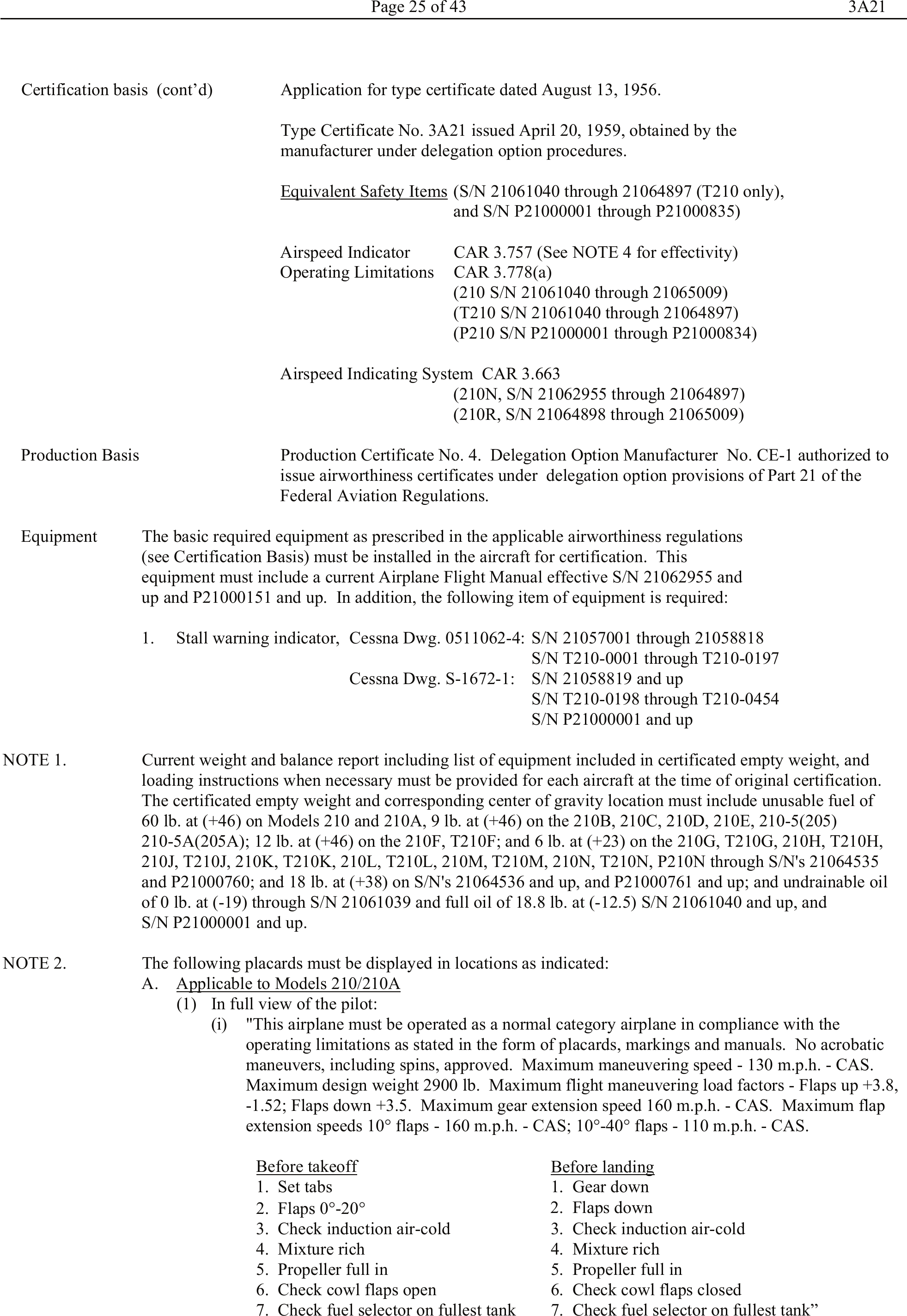
(Refer to the Type Certificate Data Sheet excerpt.) For weight and balance purposes, what is the weight of any unusable fuel on Cessna model 210 serial number 21058713?
- 9 pounds. ✓
- 12 pounds.
- 38 pounds.
Why: The same NOTE 1 entry gives 9 lb. at (+46) for the 210B, 210C, 210D and 210E, and serial 21058713 is a 210E. The 12 lb. figure in the options is the one NOTE 1 gives for the 210F and T210F, which is the very next group listed - so the difference between a right and a wrong answer here is reading the model range, not the number.
Which products may airworthiness directives be issued against, according to 39.3?
- Aircraft and aircraft engines only, since propellers and appliances are covered by the type certificate data sheet
- Any article installed on a type-certificated product, including standard parts and commercial parts
- Aircraft, aircraft engines, propellers and appliances ✓
Why: 39.3 names four kinds of product and that list is the boundary of the AD system: aircraft, aircraft engines, propellers and appliances. It is worth holding the definition alongside 39.1, which says part 39 exists to provide the legal framework for the AD system, and 39.13, which confirms that AD's are part of the Code of Federal Regulations even though they are published in the Federal Register as amendments to 39.13 rather than codified in the annual edition.
What two principles does AC 43.13-1B give for splicing stringers and flanges where the manufacturer's recommendations are not available?
- Place the splicing or reinforcing parts symmetrically about the centreline of the member, and design the splice to carry both tension and compression ✓
- Use a splice at least twice the length of the damaged section, and match the rivet pattern of the nearest undamaged joint in the same member
- Use material one gauge heavier than the original, and stagger the rivet rows so that no two rows fall in the same plane of the section
Why: Symmetry about the centreline is what stops the splice loading the member eccentrically and buckling it in compression, and the splice has to be attached to as many elements of the section as are needed to prevent bending in any direction. The circular adds a detail worth having: to avoid reducing the member's tensile strength, the rivet holes at the ends of the splice are kept small - no larger than the original skin attaching rivets - and the second row is staggered back from the ends.
The sight line drawn on material to be bent in a cornice brake is located at what position from the bend tangent line?
- The setback measurement.
- The bend radius length. ✓
- The bend allowance length.
Why: The sight line is drawn one bend radius from the bend tangent line, on the side that goes into the brake. Lined up under the nose of the radius bar, it puts the bend tangent line exactly where the bend has to start. Setback and bend allowance are both real layout dimensions but neither places this line: setback locates the bend tangent line relative to the mold line, and bend allowance is the length of material consumed between the two bend tangent lines.
Part 43 appendix B requires a person who performs a major repair or major alteration to execute FAA Form 337 at least in duplicate, give a signed copy to the aircraft owner, and
- forward a copy to the responsible Flight Standards office within 48 hours after the work is inspected and found satisfactory
- retain a copy at the place of business for at least two years from the date of approval for return to service
- forward a copy to the FAA Aircraft Registration Branch in Oklahoma City within 48 hours after the aircraft is approved for return to service ✓
Why: Appendix B(a)(3) names the office and the clock: the FAA Aircraft Registration Branch in Oklahoma City, within 48 hours after the aircraft, airframe, engine, propeller or appliance is approved for return to service. The Flight Standards office is not the addressee for the form. The two-year retention in the third option is real but it belongs to appendix B(b)(2), the alternative route open to a certificated repair station using a customer work order.
According to 21.41, what does a type certificate include?
- The type design, the operating limitations, the certificate data sheet, the regulations with which the FAA records compliance, and any other prescribed conditions or limitations ✓
- The type design and the type certificate data sheet, the other contents being held separately by the FAA aircraft certification office
- The type design and every supplemental type certificate subsequently issued against that type design by the FAA
Why: 21.41 is a single sentence and it bundles five things into the certificate. The practical consequence is that the data sheet is not a separate document of lesser standing - it is part of the type certificate, which is why an aircraft that does not conform to its data sheet does not conform to its type certificate. An STC under 21.117(b) consists of the approval of the change plus the type certificate previously issued, so it sits alongside rather than inside the original certificate.
Which appendix of 14 CFR part 43 specifies the performance of certain alterations as a major?
- Appendix A. ✓
- Appendix B.
- Appendix D.
Why: Appendix A to Part 43 is the one that classifies work: it lists major alterations, major repairs and preventive maintenance. Appendix B covers the recording of major repairs and major alterations, and Appendix D gives the scope and detail of an annual or 100-hour inspection.
Before approving a reciprocating-engine aircraft for return to service after a 100-hour inspection, which of these must the engine run establish?
- Cylinder head temperature stabilised within the green arc, and oil consumption measured over a ten minute run at cruise power
- Static and idle rpm, magneto operation, fuel and oil pressure, and cylinder and oil temperature ✓
- Idle mixture, accelerator pump operation, and magneto drop at the run-up speed
Why: 43.15(c)(2) names four things and calls the first of them power output, expressed as static and idle rpm. All of them are determined in accordance with the manufacturer's recommendations. A turbine-powered aircraft has its own rule at 43.15(c)(3) - the engines are run to determine satisfactory performance to the manufacturer's recommendations, and that rule covers progressive inspections as well as annual and 100-hour ones.
Appendix A names which of the following as an appliance major repair?
- Replacing and servicing batteries
- Complete disassembly of a complex hydraulic power valve ✓
- Cleaning or replacing an oil filter element
Why: Appendix A(b)(4)(iv) lists complete disassembly of complex hydraulic power valves among the appliance major repairs, alongside instrument calibration and repair, radio calibration, rewinding the field coil of an electrical accessory and the overhaul of pressure type carburettors and pumps. Replacing and servicing batteries is preventive maintenance under appendix A(c)(24), and cleaning or replacing fuel and oil strainers or filter elements is (c)(23).
An owner fabricates a bracket for use in maintaining that owner's own aircraft. Does 21.9 permit this?
- Yes - 21.9(a)(5) allows an article produced by an owner or operator for maintaining or altering that owner's or operator's own product ✓
- No - 21.9(a) requires every replacement or modification article likely to be installed on a type-certificated product to be produced under an FAA production approval
- Yes, provided the owner holds at least a private pilot certificate and the fabrication counts as preventive maintenance under part 43 appendix A(c)
Why: 21.9(a)(5) is the owner-produced part provision and it is limited to the owner's or operator's own product. 21.9(b) then draws the line that matters: except for articles produced under a type certificate or an FAA production approval, a person who produces a replacement or modification article FOR SALE may not represent it as suitable for installation on a type-certificated product. So the part may be made and used, but not made and sold.
A section of metal hydraulic line is to be replaced. What does AC 43.13-1B require of the replacement?
- Tubing of the same size in any material of equal or greater strength, bent to a radius at least twice that of the original line
- Tubing of the same size and material as the original, bent using the old line as a template where it is not too badly damaged ✓
- Tubing one size larger than the original, to allow for the loss of flow area at the flares and the inserted unions
Why: Same size, same material. Where the old line is too damaged to serve as a template, one can be made from soft iron wire. Soft aluminium tubing in 1100, 3003 or 5052 under a quarter of an inch outside diameter may be bent by hand; everything else needs an acceptable hand or power bending tool. Substituting a stronger material changes the way the line behaves under vibration and is not what the circular allows.
An airworthiness directive incorporates a manufacturer's service bulletin by reference, and the two documents disagree on a torque value. Which governs?
- The airworthiness directive, because where there is a conflict 39.27 requires its requirements to be followed ✓
- The service bulletin, because it is the manufacturer's own data for the product and the AD adopts it wholesale
- Whichever is the later document, since the more recent revision represents the current state of the manufacturer's knowledge
Why: 39.27 describes exactly this situation. Incorporation by reference makes the service document part of the AD, but the AD may modify the directions in it, and where the two conflict the AD's requirements are the ones to follow. Reaching for the later revision date is a common instinct and the wrong one - a service bulletin revised after the AD does not amend the AD.
To determine if an aircraft is eligible for ski installation, which document could be referenced?
- Type certificate data sheets. ✓
- Advisory Circular AC43.13-2A.
- Aircraft airworthiness certificate.
Why: Eligibility is a type design question, and the Type Certificate Data Sheet is where the approved optional equipment for a type is listed, skis included. AC 43.13-2A gives acceptable methods for alterations but does not say which aircraft are eligible, and the airworthiness certificate names the aircraft and its category without listing equipment.
When should a differential compression test be carried out, and why?
- As soon as possible after engine shutdown, to give uniform lubrication of the cylinder walls and rings ✓
- After the engine has cooled completely, so that the readings are not distorted by thermal expansion of the cylinder barrel
- After the engine has been motored on the starter for thirty seconds with the ignition off, to distribute oil evenly over the bores
Why: Testing while the engine is still warm gives uniform lubrication of the cylinder walls and rings, so the reading reflects the state of the components rather than the state of the oil film. The test itself puts air into the cylinder with the piston at top centre on the compression stroke and both valves closed, and the regulated pressure is set and then rechecked at 80 psi with air flowing into the cylinder.
A Cessna 421B operated as a 14 CFR part 91 airplane would have inspections conducted in accordance with
- 14 CFR part 43, appendix D.
- 14 CFR part 91, section 91.409 (Inspections). ✓
- 14 CFR part 43, section 43.16 (Airworthiness Limitations).
Why: 91.409 is the rule that requires the inspection and sets the interval. Appendix D to Part 43 is not a requirement in its own right - it prescribes the scope and detail once 91.409 has told you an inspection is due - and 43.16 deals with airworthiness limitations, which is a separate obligation.
An object rests on two scales. The front scale reads 700 lb at an arm of 20 inches and the rear scale reads 800 lb at an arm of 130 inches. Where is the centre of gravity?
- 71.3 inches aft of the datum
- 78.7 inches aft of the datum ✓
- 75.0 inches aft of the datum
Why: Centre of gravity is the total moment divided by the total weight. The moments are 700 times 20, or 14,000 in-lb, and 800 times 130, or 104,000 in-lb, giving 118,000 in-lb over a total of 1,500 lb, which is 78.67 inches. Each wrong answer is a specific slip: 75.0 is the plain midpoint of the two arms, which would only be right if the two scale readings were equal, and 71.3 comes from swapping the two readings between the arms.
In what form and language must the Instructions for Continued Airworthiness be prepared?
- In the English language, as a single bound manual with numbered chapters following the ATA 100 specification for the airplane concerned
- In the English language, as a manual or manuals appropriate for the quantity of data, in a practical arrangement ✓
- In the language of the state of registry of the first airplane delivered, in whatever arrangement the applicant finds practical
Why: Appendix A sets three requirements between its format and contents paragraphs: a manual or manuals as appropriate for the quantity of data, a practical arrangement, and the English language. It does not prescribe a chapter numbering system - ATA 100 is an industry convention that many manufacturers follow, not a regulatory requirement - and it does not vary with the state of registry.
Where must the Airworthiness Limitations section appear if the Instructions for Continued Airworthiness consist of several documents?
- In the principal manual ✓
- In each of the documents making up the Instructions for Continued Airworthiness, so that it cannot be missed by anyone using any one of them
- In a separate document issued to the owner on delivery and revised by the design approval holder whenever a limitation changes
Why: Appendix A says it plainly - where the ICA consist of multiple documents, the Airworthiness Limitations section must be included in the principal manual. The same paragraph requires it to be segregated and clearly distinguishable from the rest of that document, which is the practical reason for putting it in one known place rather than repeating it.
The Airframe handbook gives minimum edge distances for a repair. What are they for protruding head and for countersunk rivets?
- Two rivet diameters for protruding head rivets and two and a half for countersunk rivets ✓
- Two rivet diameters for both, the difference between the two types being taken up in the rivet spacing instead
- Two and a half rivet diameters for protruding head rivets and three for countersunk rivets
Why: The countersunk rivet needs the extra half diameter because the countersink removes material from the sheet around the hole. The handbook adds a preferred figure for each - the minimum plus one sixteenth of an inch - and gives the reason: leaving that margin means a hole can be drilled oversize later, for a damaged or loose rivet, without taking the edge distance below the minimum.
When may the maintenance instructions refer the reader to an accessory, instrument or equipment manufacturer for the scheduling information?
- Whenever the item was not manufactured by the holder of the type certificate for the airplane
- Where the applicant shows that the item has an exceptionally high degree of complexity requiring specialised maintenance techniques, test equipment or expertise ✓
- Whenever the applicant has obtained that manufacturer's written agreement to supply the information on request to any owner or operator of an airplane of the type concerned
Why: Appendix A23.3(b)(1) allows the cross reference only on that showing, and the three grounds are alternatives within one test of complexity. Being someone else's product is not enough on its own - most of what is installed in an aeroplane is - and a supply agreement addresses availability rather than the reason the information is held elsewhere.
A propeller-equipped aircraft vibrates only between 2,200 and 2,350 rpm. What does the handbook say this indicates?
- Not normally a propeller problem, but a poor engine-propeller match ✓
- A propeller balance problem, since an out-of-balance condition shows up most strongly at the resonant speed of the blades
- A cracked or deformed spinner, which produces a vibration confined to a narrow band of engine speed
Why: The distinction the handbook draws is by rpm range. A propeller that vibrates because of balance, angle or track typically vibrates throughout the whole rpm range, though the intensity may vary; vibration confined to one speed or a narrow band points to a poor engine-propeller match instead. A spinner problem is diagnosed differently again - by a noticeable spinner wobble with the engine running, usually from inadequate shimming of the front support or a cracked or deformed spinner.
What is the K-factor, and what value does it take for a 90 degree bend?
- The ratio of the bend radius to the metal thickness; it is 1 for a 90 degree bend in material of any thickness
- The percentage of the material thickness that lies on the compression side of the neutral axis; it is 0.5 for a 90 degree bend
- The tangent of one half of the bend angle; it is 1 for a 90 degree bend ✓
Why: K is the tangent of half the bend angle - tan 45 degrees for a 90 degree bend, which is exactly 1 - and that is why setback for a 90 degree bend reduces to the familiar R plus T with no multiplier in sight. The K chart carries one of 179 numbers, one for each whole angle between 0 and 180 degrees, and the handbook says outright that the K-factor must be used for all bends smaller or larger than 90 degrees.
Which of the following statements are true concerning the use of manufacturer`s service bulletins (SB) and compliance with airworthiness directives (AD)?
- If there is a conflict between an SB and an AD, the manufacturer service bulletin should take precedence.
- If there is a conflict between an SB and an AD, you should always follow the AD. ✓
- Manufacturer's service bulletins are always mandatory.
Why: 39.7 makes failure to comply with an AD a violation - an AD is a legally enforceable rule, while a service bulletin is the manufacturer's recommendation. A bulletin becomes mandatory only where an AD or another rule adopts it, so where the two disagree the AD governs.
What rivet alloy should be selected for a repair, where the choice is open?
- The same alloy number as the material being riveted, wherever possible ✓
- The highest strength alloy that can be driven with the equipment available, so that the joint is stronger than the original
- 5056 rivets in every case, because their corrosion resistance protects the joint against dissimilar metal attack
Why: Matching the alloy keeps the rivet and the sheet behaving alike - 1100 and 3003 rivets in 1100 and 3003 parts, 2117-T and 2017-T rivets in 2017 and 2024 parts. Deliberately over-strong rivets are not a safe default, because the joint then fails in the sheet rather than in the fastener. 5056 rivets have a specific job: they are used exclusively when riveting magnesium alloy structures, for their corrosion resistance in that combination.
Helicopters manufactured after September 16, 1992 are required to have
- an anti-torque warning light.
- safety belts and shoulder harnesses. ✓
- an emergency locator transmitter.
Why: 14 CFR 91.205 sets that date against a shoulder harness for each seat meeting 27.2 or 29.2, on top of the safety belt required for every occupant. It is a required-equipment item you would confirm during an inspection. An anti-torque warning light is not a required item, and ELT requirements come from 91.207 and are not tied to that date.
Under 43.9(a), what must a maintenance record entry contain when a mechanic completes work other than a required inspection?
- A description of the work performed, the total time in service of the airframe at completion, and the signature and certificate number of the person approving the work
- A description of the work performed, the date of completion, and a statement that the aircraft has been determined to be in airworthy condition
- A description of the work performed, the date of completion, and the signature, certificate number and kind of certificate held by the person approving the work ✓
Why: 43.9(a) lists four things: a description of the work, or a reference to data acceptable to the Administrator; the date of completion; the name of the person who did the work if that is not the person signing; and the signature, certificate number and kind of certificate held by the person approving the work. Total time in service belongs to inspection entries under 43.11(a)(2), and the airworthy-condition certification belongs to 43.11(a)(4) - both are inspection records, which 43.9 expressly does not cover.
Under 91.403(c), what must have been complied with before an aircraft with an Airworthiness Limitations section may be operated?
- The mandatory replacement times, inspection intervals and related procedures in that section, or approved alternatives set out in operations specifications or an inspection program approved under 91.409(e) ✓
- Every recommendation contained in the manufacturer's maintenance manual and in any service bulletin issued against the aircraft type
- The current status of all life-limited parts as recorded under 91.417(a)(2)(ii), which must be reviewed before each flight
Why: 91.403(c) is written as a prohibition on operating and it names the same three alternatives 43.16 does. The distinction worth holding is that 43.16 binds the person doing the maintenance and 91.403(c) binds the operator, so a lapse shows up twice. Service bulletins are acceptable data and are not mandatory unless an airworthiness directive makes them so, and the life-limited part status is a record-keeping duty rather than a pre-flight one.
How does 14 CFR part 1 define a major repair?
- A repair that, if improperly done, might appreciably affect weight, balance, structural strength, performance, powerplant operation or flight characteristics, or that cannot be done by elementary operations ✓
- A repair to any of the parts listed in part 43 appendix A(b), whatever the method used to carry it out
- A repair that requires the use of data approved by the FAA, or that must be recorded on FAA Form 337 and forwarded to Oklahoma City
Why: Part 1 gives a two-limb test and either limb is enough: the consequences if the repair is done badly, or the fact that it is not done according to accepted practices and cannot be done by elementary operations. Appendix A of part 43 is the worked list that applies that test to named components - useful in the field, but it is downstream of the definition, not the definition itself. The approved data and the Form 337 are consequences of a repair being major, not the reason it is.
Which of these is specifically named in 14 CFR part 43 appendix A as an airframe major alteration?
- A change to the empty weight or empty balance that raises the aircraft's maximum certificated weight ✓
- Replacing a side window where the work does not interfere with any operating system
- Applying a protective coating where no primary structure is disassembled
Why: Appendix A(a)(1)(xi) names changes to the empty weight or empty balance which result in an increase in the maximum certificated weight or centre of gravity limits. The other two options are quoted from appendix A(c), the preventive maintenance list - replacing side windows is item (13) and applying preservative or protective material is item (10). Both lists are in the same appendix, which is why they are easy to confuse.
A light twin-engine airplane has its empty weight center of gravity at 24.5 percent of the mean aerodynamic cord (MAC). Using the following information, determine the location of the center of gravity in inches. MAC 75.5 inches. Leading edge of MAC at flight station 144.8. Empty weight 7201 lbs.
- 158.76
- 163.29 ✓
- 175.15
Why: A percentage of MAC is measured aft from the leading edge of the MAC, so the station is the leading edge plus that fraction of the chord: 144.8 plus 0.245 times 75.5, which is 144.8 plus 18.4975, or 163.2975 inches. The empty weight of 7201 lb is not needed for this calculation at all - it is there to be picked up and used by mistake.
How is the loading graph and CG envelope system used to check a loaded aircraft?
- Total weight is plotted against the arm of each loaded station in turn, and the aircraft is within limits if every plotted point falls inside the envelope
- The moment of each item is read from the loading graph and summed, and the aircraft is within limits if the total does not exceed the maximum moment printed on the envelope
- Total weight is plotted on the vertical scale and total moment on the horizontal scale, and the aircraft is within limits if the intersection falls inside the envelope ✓
Why: The loading graph gives the moment for each item loaded, all the weights and all the moments are summed, and that single pair of totals is plotted on the envelope. Where the horizontal line from the weight and the vertical line from the moment cross is the loaded CG, and inside the envelope means within limits. An aircraft certificated in both normal and utility categories will have two envelopes on the same chart, so the right one has to be chosen for the category being flown.
Which rivets may be driven in the condition received, and which must be kept refrigerated or reheat treated before driving?
- 2017 and 2024 rivets may be driven as received; 2117 rivets must be refrigerated because of their higher copper content
- All aluminium alloy rivets must be refrigerated, the only exception being 1100 rivets used on non-structural parts
- 2117 rivets may be driven as received; 2017 rivets above 3/16 inch diameter and all 2024 rivets must be refrigerated or reheat treated ✓
Why: 2117-T4 is the most commonly used rivet in aluminium alloy structures precisely because it needs no further treatment before driving. The harder alloys age after solution heat treatment, so 2017 rivets above 3/16 inch and all 2024 rivets are packed in dry ice or refrigerated in the quenched condition until driven, or reheat treated immediately beforehand - otherwise they are too hard to rivet satisfactorily and will crack.
If an aircraft receives a replacement engine between annual inspections, what action would be required?
- A 100-hour inspection of the engine followed by a flight test.
- An inspection as required by the manufacturer and a maintenance record entry. ✓
- Only the engine portion of the annual inspection with an entry in the engine's record.
Why: Changing an engine is maintenance, so two ordinary obligations attach: 43.13(a) requires the methods and practices in the manufacturer's maintenance manual or Instructions for Continued Airworthiness, and 43.9 requires a maintenance record entry for the work. Nothing in part 91 turns an engine change into a 100-hour inspection or demands a flight test, and there is no such thing as running one portion of an annual on its own.
What is rivet edge distance, and what minimum does AC 43.13-1B give for a single row of rivets?
- The distance from the edge of the rivet head to the edge of the sheet, with a minimum of three rivet diameters
- The distance from the centre of one rivet hole to the centre of the next, with a minimum of two rivet diameters
- The distance from the centre of the rivet hole to the nearest edge of the sheet, with a minimum of two rivet diameters ✓
Why: Edge distance is measured from the CENTRE of the hole, not from the head, and the single-row minimum is two diameters with a spacing minimum of three diameters. The third option describes rivet SPACING, which is the centre to centre distance between adjacent holes - a different measurement in the same paragraph. Note the condition attached to all of this: unless structural deficiencies are suspected, the spacing and edge distance should duplicate those of the original structure rather than being recalculated.
Who must the owner make the maintenance records available to, and on what terms?
- The Administrator only, and then only at the aircraft's home base during a normal working week, the owner being entitled to reasonable notice
- The Administrator or an authorised representative of the NTSB, and the Form 337 to any law enforcement officer on request ✓
- Any prospective purchaser, insurer or maintenance provider who can show a legitimate interest in the aircraft, on reasonable notice to the owner
Why: 91.417(c) is in two parts and both are worth holding: all the records required by the section are available for inspection by the Administrator or any authorised representative of the National Transportation Safety Board, and the Form 337 described in 91.417(d) must additionally be presented for inspection on the request of any law enforcement officer. The section imposes no place or time limit, and gives no rights to insurers or purchasers.
Which aircraft is NOT subject to the annual and 100-hour inspection requirements of 91.409(a) and (b)?
- An aircraft operated under part 91 for personal use only
- An aircraft that has fewer than 100 hours on the airframe since new and has not yet reached its first 100-hour inspection
- An aircraft holding a current experimental airworthiness certificate ✓
Why: 91.409(c)(1) excepts an aircraft carrying a special flight permit, a current experimental airworthiness certificate, a special airworthiness certificate in the light-sport category or a provisional airworthiness certificate. Neither wrong answer touches that list. Personal use exempts nothing - the annual applies to every aircraft not otherwise excepted - and hours in service have no bearing on it either, because 91.409(a) runs on calendar months. A brand new aircraft that has flown two hours still needs an annual within 12 calendar months of the inspection for the issue of its airworthiness certificate.
Which of the following may a manufacturer do under 43.3(j) without holding any other certificate?
- Approve for return to service any product of its own manufacture, whatever the data the work was performed to and whoever performed it
- Rebuild or alter any aircraft, engine, propeller or appliance it manufactured under a type or production certificate ✓
- Perform an annual inspection on any aircraft of a type it manufactures, wherever and by whomever that particular aircraft was built
Why: 43.3(j) gives the manufacturer three specific authorities: rebuild or alter products it manufactured under a type or production certificate; rebuild or alter appliances or parts it manufactured under a TSO authorization, a PMA or a product and process specification; and perform part 91 or part 125 inspections on aircraft it manufactured under a type certificate or currently manufactures under a production certificate. 43.7(d) then limits the return to service privilege - except for minor alterations, the work must have been done to data approved by the Administrator.
What does a cylinder compression test determine, and what is it for?
- Whether the cylinder is developing its rated power, so as to establish the engine's remaining service life before overhaul
- Whether the valve clearances are correctly set, so as to decide whether the rocker covers need to come off at this inspection
- Whether the valves, piston rings and pistons are sealing the combustion chamber, so as to decide whether cylinder replacement is necessary ✓
Why: The test is about sealing, and the decision it supports is a cylinder change - the handbook's point being that finding and replacing a defective cylinder prevents a complete engine change through cylinder failure. Low compression can most often be traced to leaky valves. Incorrect valve clearances are one of the CONDITIONS that affect compression, alongside a worn or damaged piston, excessive wear of rings and cylinder walls, burned or warped valves, and carbon between a valve face and its seat.
An airplane with an empty weight of 2,350 lb and an EWCG of +24.7 inches has a 7.3 lb GPS installed at an arm of -26 inches and a 34 lb seat removed from an arm of +60 inches. What is the new empty weight and EWCG?
- 2,391.3 lb at +25.05 inches
- 2,323.3 lb at +24.19 inches
- 2,323.3 lb at +24.02 inches ✓
Why: Work in moments. The original moment is 2,350 times 24.7, or 58,045 in-lb. The GPS adds 7.3 lb and a moment of -189.8 in-lb, because its arm is forward of the datum. Removing the seat subtracts 34 lb and subtracts its moment of +2,040 in-lb. That leaves 2,323.3 lb and 55,815.2 in-lb, so the new EWCG is +24.02. Each distractor is one specific slip: the second adds the removed seat instead of subtracting it, and the third treats the GPS arm as positive when it is forward of the datum.
For most airplanes, if the center of gravity is located at 25% of the mean aerodynamic chord, the center of lift will
- be forward of the center of gravity.
- coincide with the center of gravity.
- be behind the center of gravity. ✓
Why: The same design relationship answers this: the centre of gravity sits slightly forward of the centre of lift, so wherever the CG is placed within its range - 25% of the mean aerodynamic chord included - the centre of lift lies behind it. If the centre of lift were forward of the CG the aircraft would be unstable in pitch, and the nose-down tendency the tail is built to balance would not exist.
An applicant fails the written test required by 65.91(c)(5). When may that applicant apply for retesting?
- After 30 days, or sooner on the recommendation of the responsible Flight Standards office
- Not until at least 90 days after the date the test was failed ✓
- At any time, provided a different testing centre is used for the second attempt
Why: The closing sentence of 65.91 sets a flat 90-day wait after a failed inspection authorization written test, with no discretion attached to it and no alternative route through a different testing centre. The same test is the one described in 65.91(c)(5) as covering the ability to inspect according to safety standards for returning aircraft to service after major repairs and major alterations and annual and progressive inspections.
When may an owner start a new maintenance record, without previous operating history, for an aircraft engine?
- After the engine has been rebuilt by the manufacturer, or by an agency approved by the manufacturer ✓
- After an overhaul performed by a certificated repair station rated for that engine and tested to approved standards and technical data
- After any major repair to the engine that is recorded on FAA Form 337 and forwarded to Oklahoma City
Why: 91.421(a) limits the zero-time record to an engine rebuilt by the manufacturer or by an agency approved by the manufacturer - nobody else, however capable. 91.421(b) then requires whoever grants the zero time to enter a signed statement of the date the engine was rebuilt, each change made as required by airworthiness directives, and each change made under a manufacturer's service bulletin where the bulletin specifically asks for the entry. An overhaul, however thorough, does not reset the record.
Under 39.5, what two findings must the FAA make before it issues an airworthiness directive?
- That an unsafe condition exists in the product, and that the condition is likely to exist or develop in other products of the same type design ✓
- That an unsafe condition exists in the product, and that the manufacturer has declined to issue a service bulletin addressing it
- That a design or manufacturing defect has been confirmed, and that at least one accident or serious incident has been attributed to it
Why: 39.5 has exactly two limbs and the second is what makes an AD a rule rather than a repair order: the condition must be likely to exist or develop in other products of the SAME TYPE DESIGN. That is why an AD is written against a type and not against a serial number, and why a one-off defect in one airframe is dealt with by maintenance rather than by rulemaking. Neither a manufacturer's inaction nor an accident history is a precondition.